The expensive fallacy: “I'll just print it”
With a paper invoice it was simple: the sheet in your hand was the original. Many carry this reflex into the digital world — and stumble.
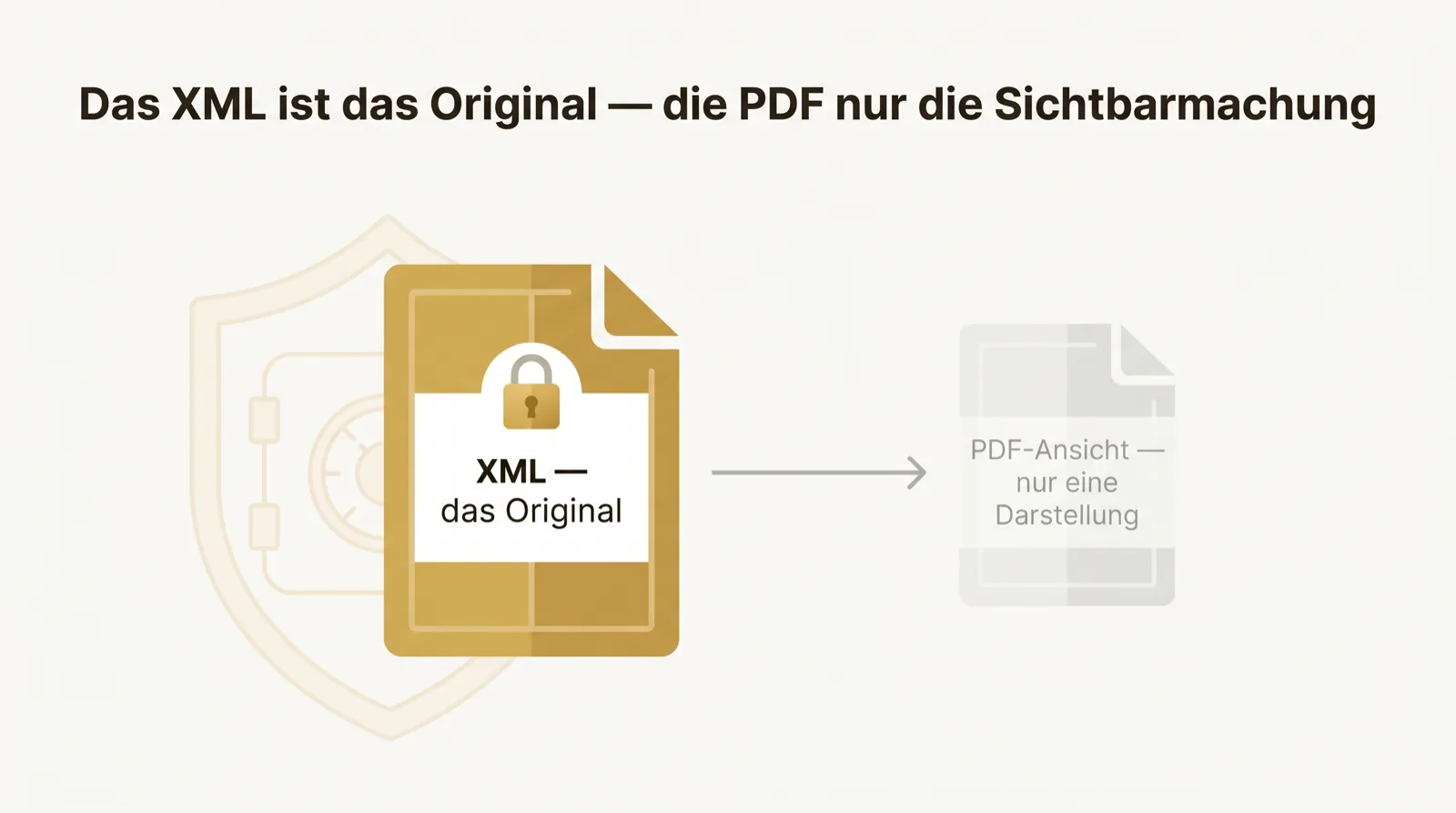
With an XRechnung the printout is not the original. It is one of many possible renderings of an XML file. Whoever keeps only the printout or a PDF made from it has thrown away the actual document and kept a copy. In a tax audit that is a problem that can no longer be repaired.
Original and rendering are two different things
The XML file contains the binding data. It is the document. Everything else — the view in the KoSIT viewer, a generated PDF, a printout — is only a rendering of that data for the human eye.
You can produce ten differently looking PDFs from the same XML. Which of them would then be “the invoice”? None. That is the point. Subject to retention is what you received: the structured original. You may additionally store the pretty view, but it cannot replace the XML.
What the GoBD concretely require of you
The GoBD — the principles for the proper keeping and retention of books in electronic form, set out in the Federal Ministry of Finance letter of 28 November 2019 — sound unwieldy but boil down to a few demands.
The document must be complete. It must be stored unalterably, that is in a way that excludes later changes or logs them seamlessly. It must remain legible and machine-evaluable in its original form. And the whole path must be traceable for an expert third party. A PDF in the “Invoices 2026” folder fulfils none of this reliably.
Eight or ten years? The retention period
For accounting vouchers — and an incoming invoice is an accounting voucher — the retention period was reduced in principle from ten to eight years from 2025 by the Fourth Bureaucracy Relief Act.
Sounds like relief, but is no reason for carelessness. For certain records it stays ten years, and the period only starts at the end of the calendar year in which the invoice arose. Eight years of seamlessly retrievable, unchanged XML — that is the actual requirement. Whoever notices in year seven that only PDFs exist has a problem without a solution.
What exactly belongs in the archive — not just the XML
The XML is the obligation. A clean filing goes a little further because it secures traceability:
- The original XML file (for ZUGFeRD: the PDF including embedded XML), unchanged.
- A readable view (e.g. a generated PDF) — convenient, but no substitute for the original.
- The intake proof: when did the invoice arrive, via which channel?
- The check and approval log: who validated and approved, when?
- An integrity proof such as a hash value showing the file has not changed since intake.
Typical errors that show up in a tax audit
Auditors today ask specifically for the structured original. It is always the same gaps that then become visible.
Only the PDF saved, the XML discarded. Invoices “archived” in a mailbox anyone can change and empty. No procedural documentation, that is no description of how the process even runs. Files renamed or replaced after the fact, without a log. Each single one of these points can call the orderliness of the bookkeeping into question — and in the worst case lead to estimation.
What a clean filing looks like in practice
You do not need an expensive document management system. You need a process that runs automatically and always the same from intake.
The invoice is secured at the moment of intake in its original format, with a timestamp, write-protected. A readable view is additionally generated, not instead of the original. Every access and every approval is logged. And the period runs along automatically so nothing is deleted too early. That is exactly what a dedicated inbox solution is built for — it makes the XML the original, not chance.