Understand, implement and archive e-invoicing.
The e-Rechnung Inbox knowledge centre brings together concise guides for German SMEs and tax advisors. It answers common questions about XRechnung, ZUGFeRD, DATEV import, GoBD-ready archiving, and Germany's e-invoicing obligation with direct explanations, processes, comparisons, and FAQs. Every article links to related topics and displays its latest update.
Receiving XRechnung: Obligation, channel and safe processing
XRechnung is the pure-XML form of the e-invoice — and since 2025 you must be able to receive it, whether you want to or not. What “being able to receive” actually means, which channel is enough, and how a cryptic file becomes a properly processed document.
E-invoicing obligation 2025/2026: who must do what, and when
The e-invoicing obligation has applied since 2025 — but in stages, and that is exactly what causes confusion. Who has to receive, who has to send, from when? A clear sorting that also clears up the most common misconception.
E-invoice for small-business owners: meeting the receiving obligation without panic
As a small-business owner under § 19 UStG you are doubly lucky with the e-invoice — and once unlucky. You don't have to send for now. But you do have to receive, since 1 January 2025. What that concretely means, what you may ignore and what you may not.
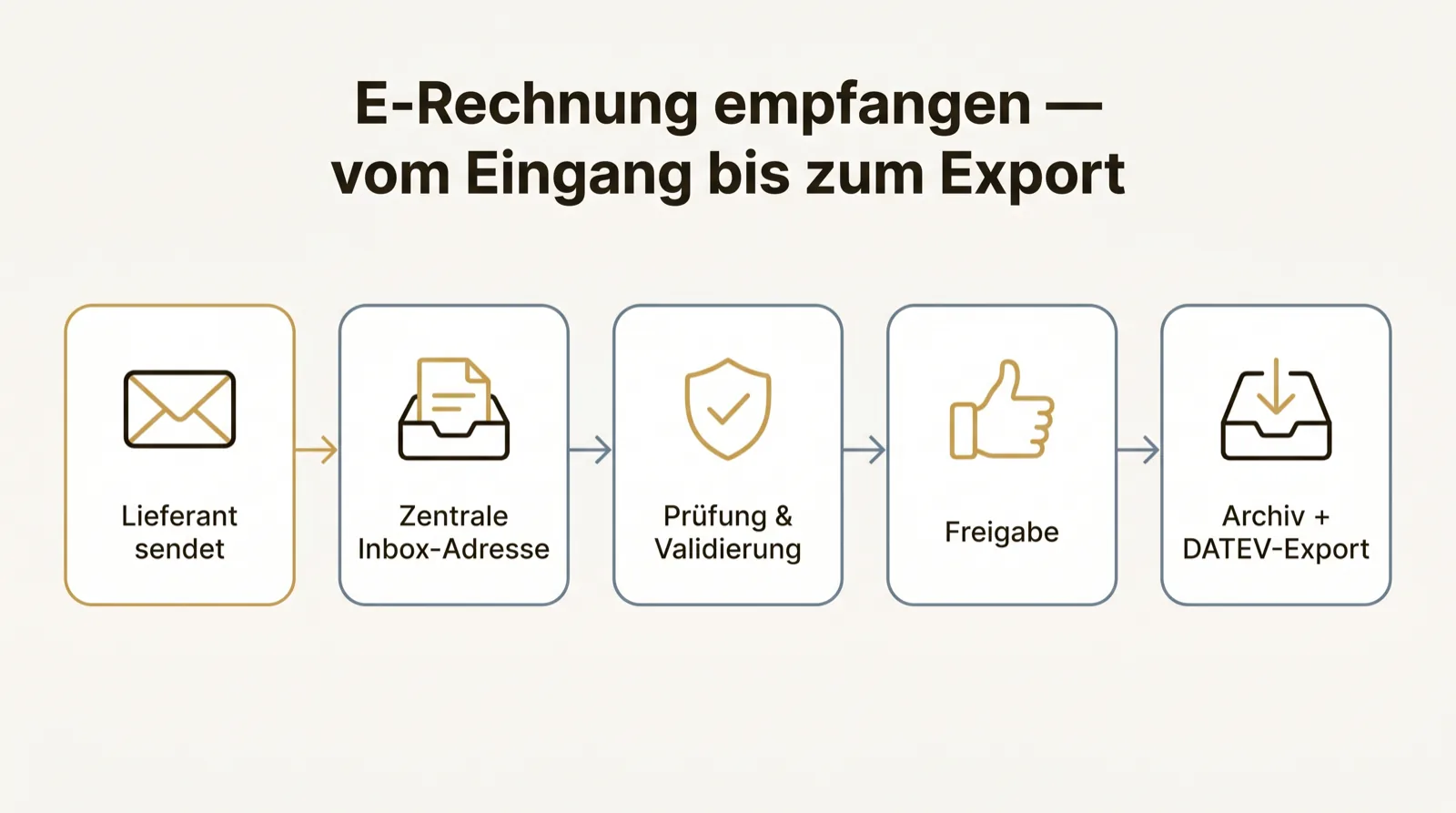
Receiving e-invoices in 2026: what companies really need now
Since 1 January 2025 every company in Germany must be able to receive e-invoices. Many may still send the old way — but not receive. This guide shows what is technically and organizationally needed in 2026: from the inbound address through validation to GoBD-compliant archiving.
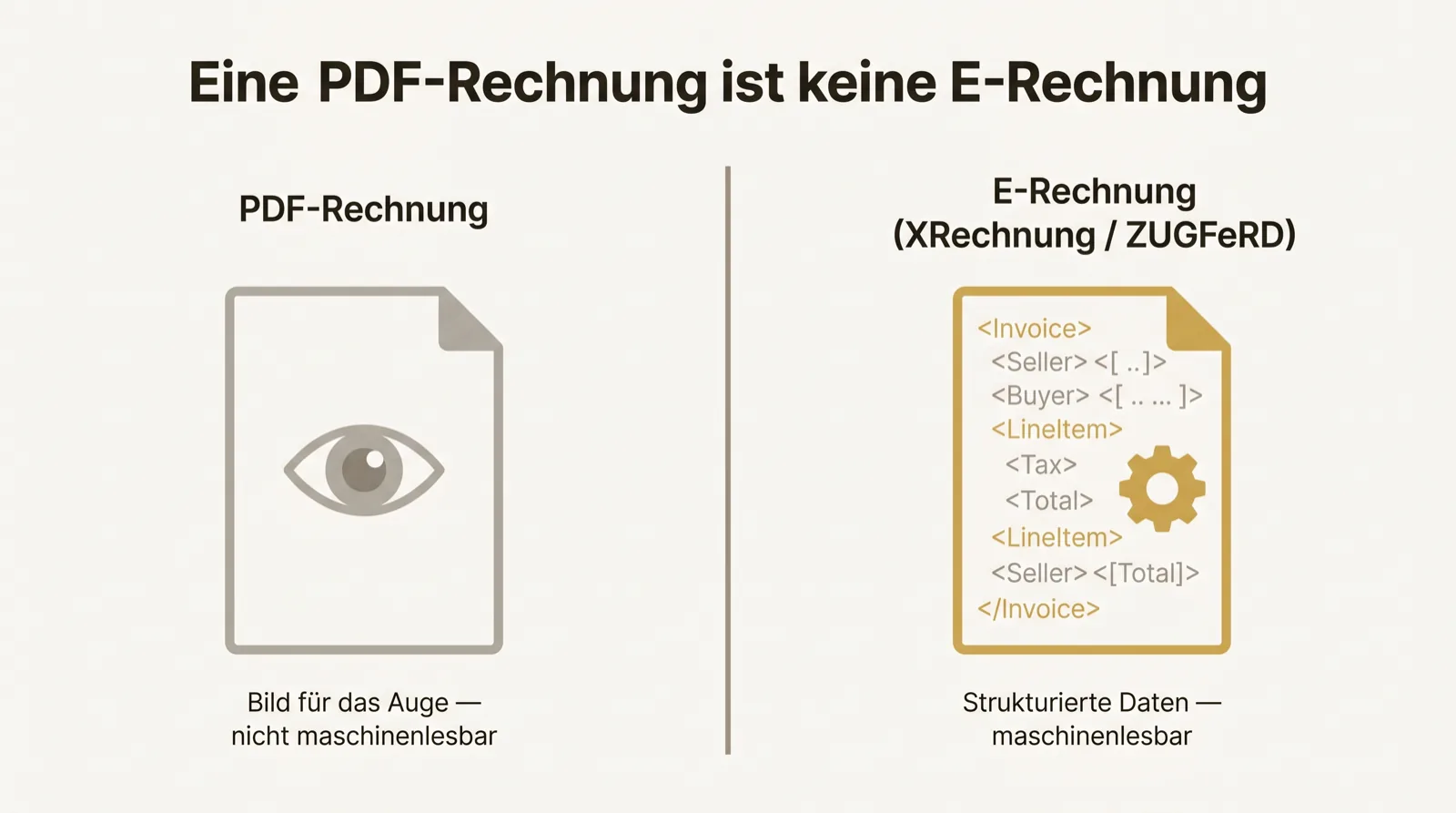
PDF invoice or e-invoice? The difference from 2025, simply explained
“We already send digital invoices as PDF.” That sentence comes up in almost every conversation — and it rests on a misunderstanding. A PDF is not an e-invoice. What exactly the difference is, why it matters since 2025 and whether you may still receive PDFs: here, briefly and without tech jargon.
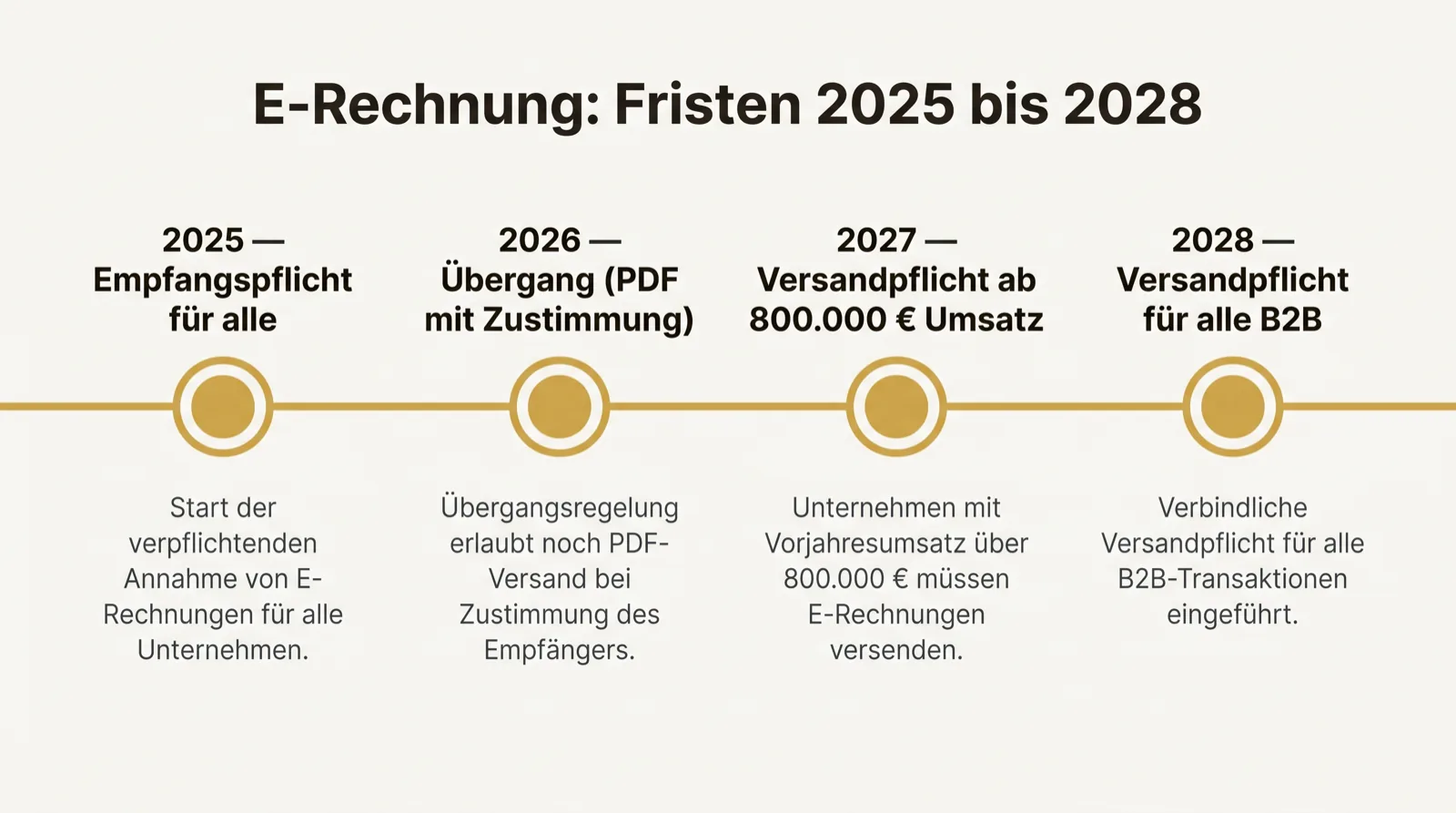
E-invoicing obligation 2027: what changes for companies above EUR 800,000 turnover
2025 was about receiving. 2027 makes sending serious — first for the larger companies. Anyone with more than EUR 800,000 prior-year turnover then loses the paper and PDF tolerance. What this concretely means and why receiving remains the more urgent task.
Receiving e-invoices by e-mail: is a mailbox really enough?
The law prescribes no particular channel for receiving — an e-mail mailbox is formally enough. And yet “we do have an info@ address” is the most common weak point in invoice intake. Why, and when a mailbox tips over.
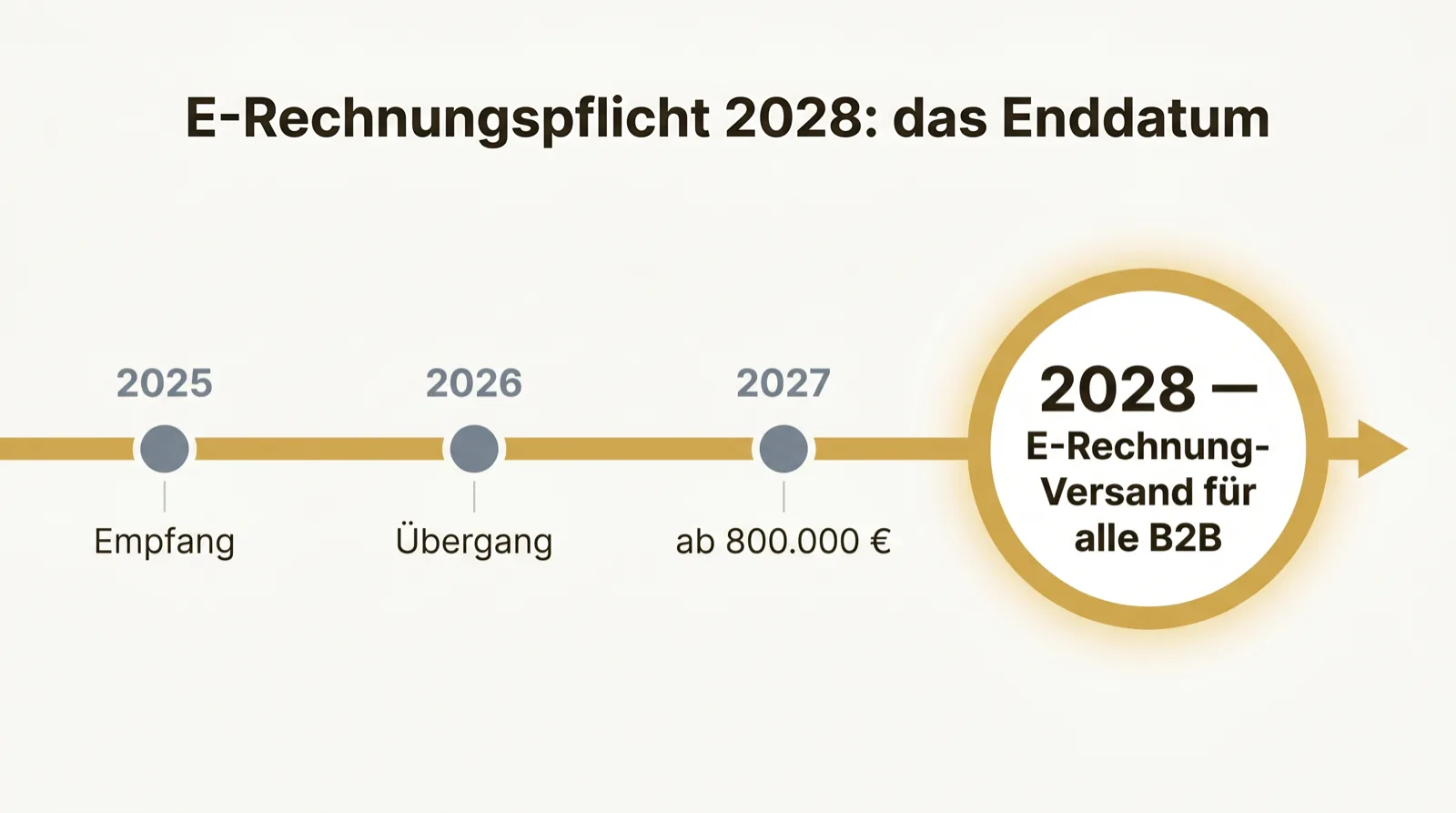
E-invoicing obligation 2028: the roadmap for small companies
2028 is the year the last exceptions for sending run out. For smaller companies that were allowed to defer, it then gets serious. What applies in 2028, who is affected — and why receiving still matters today.
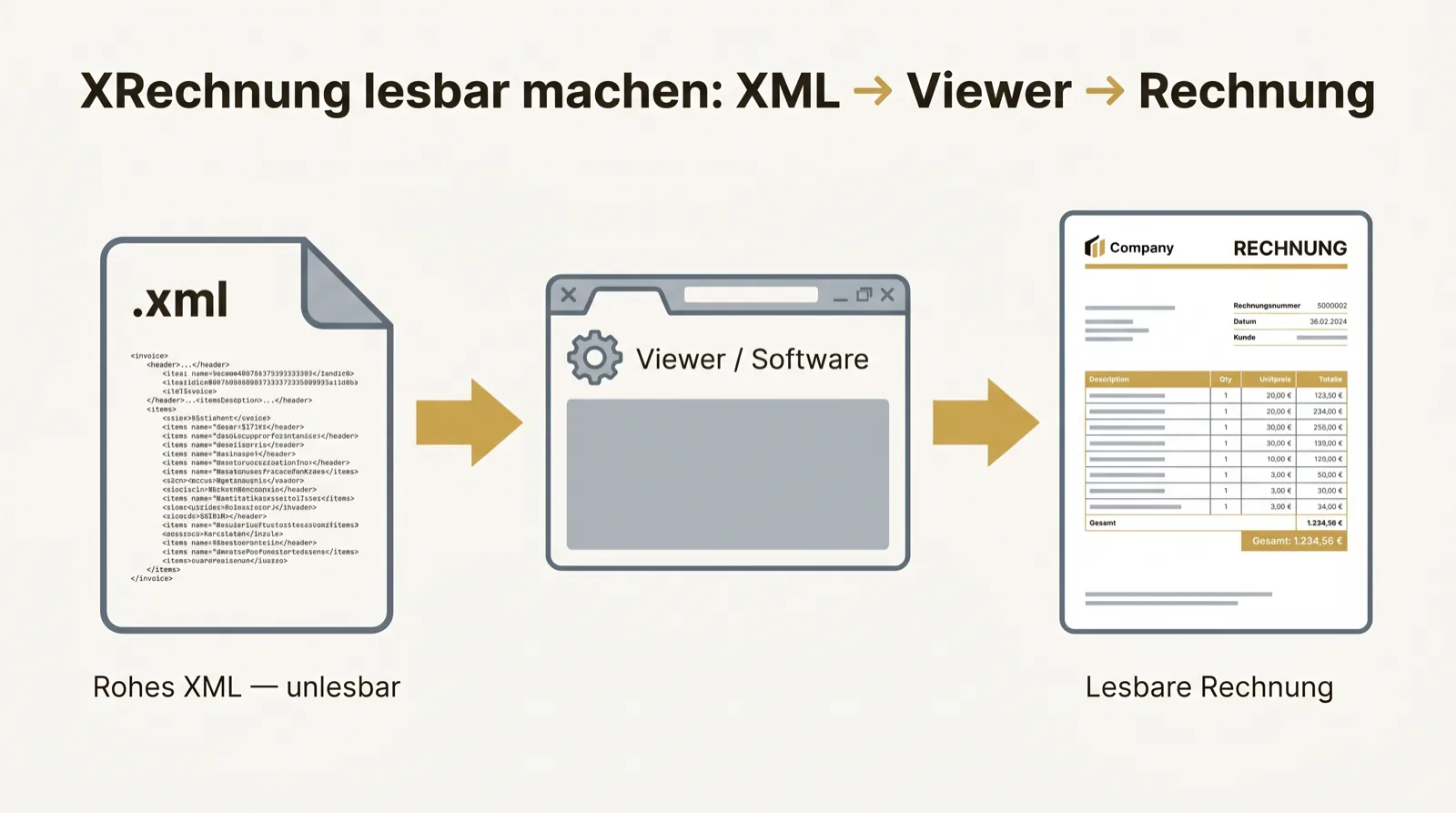
Opening an XRechnung: how to make XML invoices readable
Double-click the XRechnung — and cryptic code appears instead of an invoice. Not an error, but the format. This guide shows step by step how to make an XRechnung readable, which tools are useful and why you must keep the original anyway.
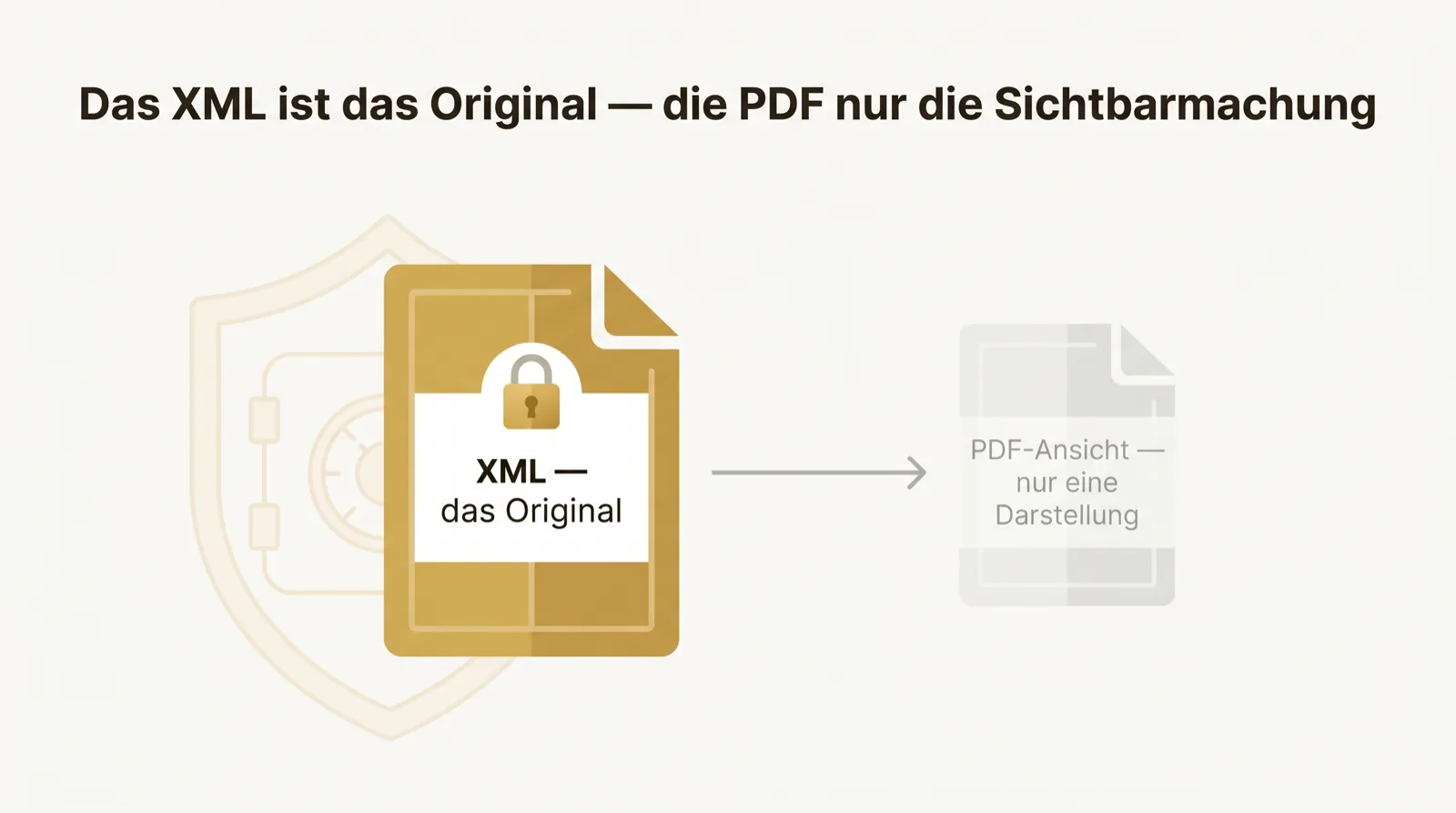
Archiving an XRechnung: why the XML is the actual original
An XRechnung comes in, someone opens it in a viewer, prints it or saves a PDF — done. Almost everyone does it this way. And this is exactly how the original is lost. Why with an XRechnung the XML file counts and not the printout, and how a filing looks that survives a tax audit.
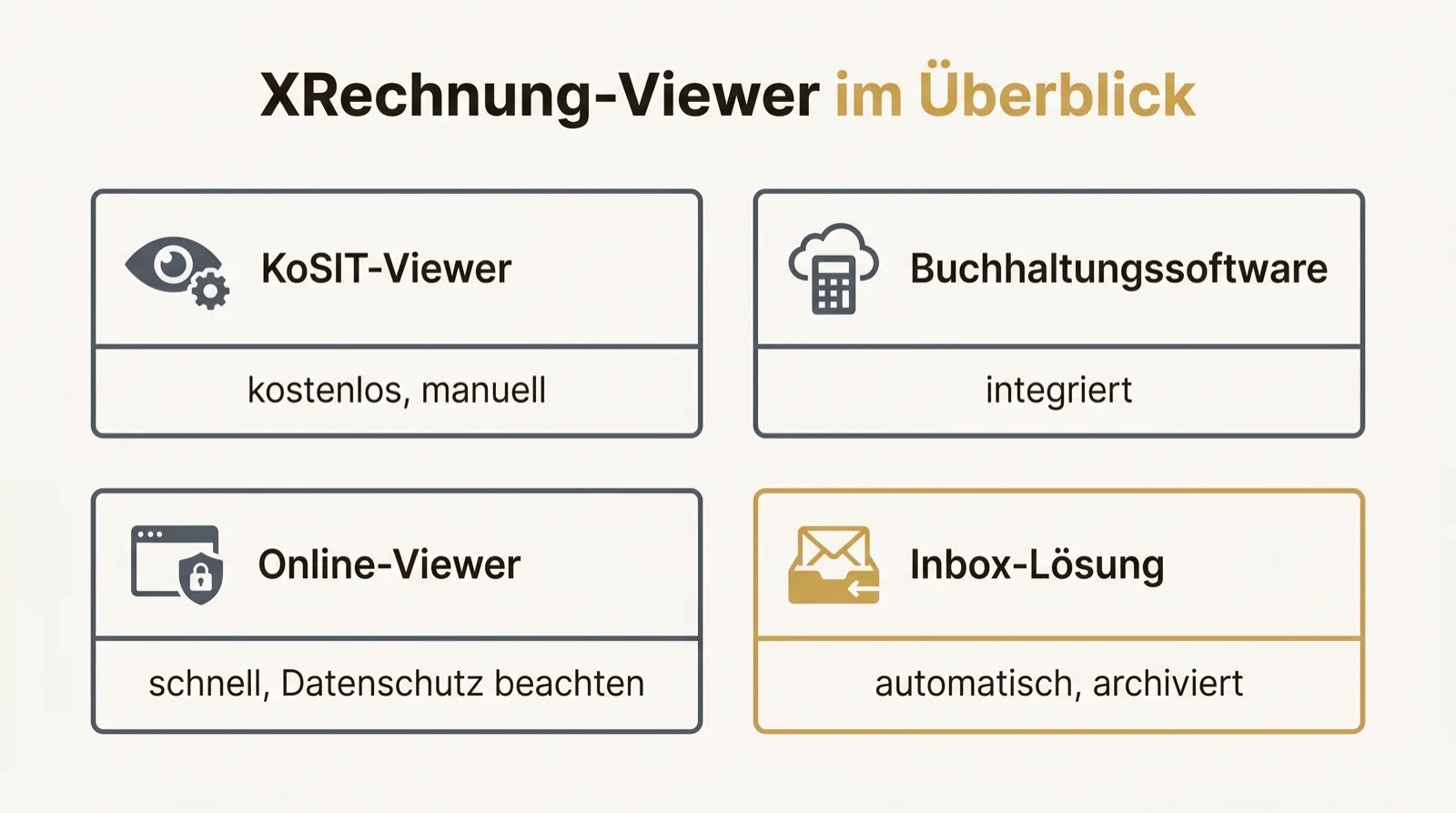
XRechnung viewer: free tools, limits and better alternatives
“I just need a viewer.” True — until you manually upload the twentieth invoice, have no validation and the original is nowhere stored cleanly. What free viewers can do, where they stop and when something else is the more honest solution.
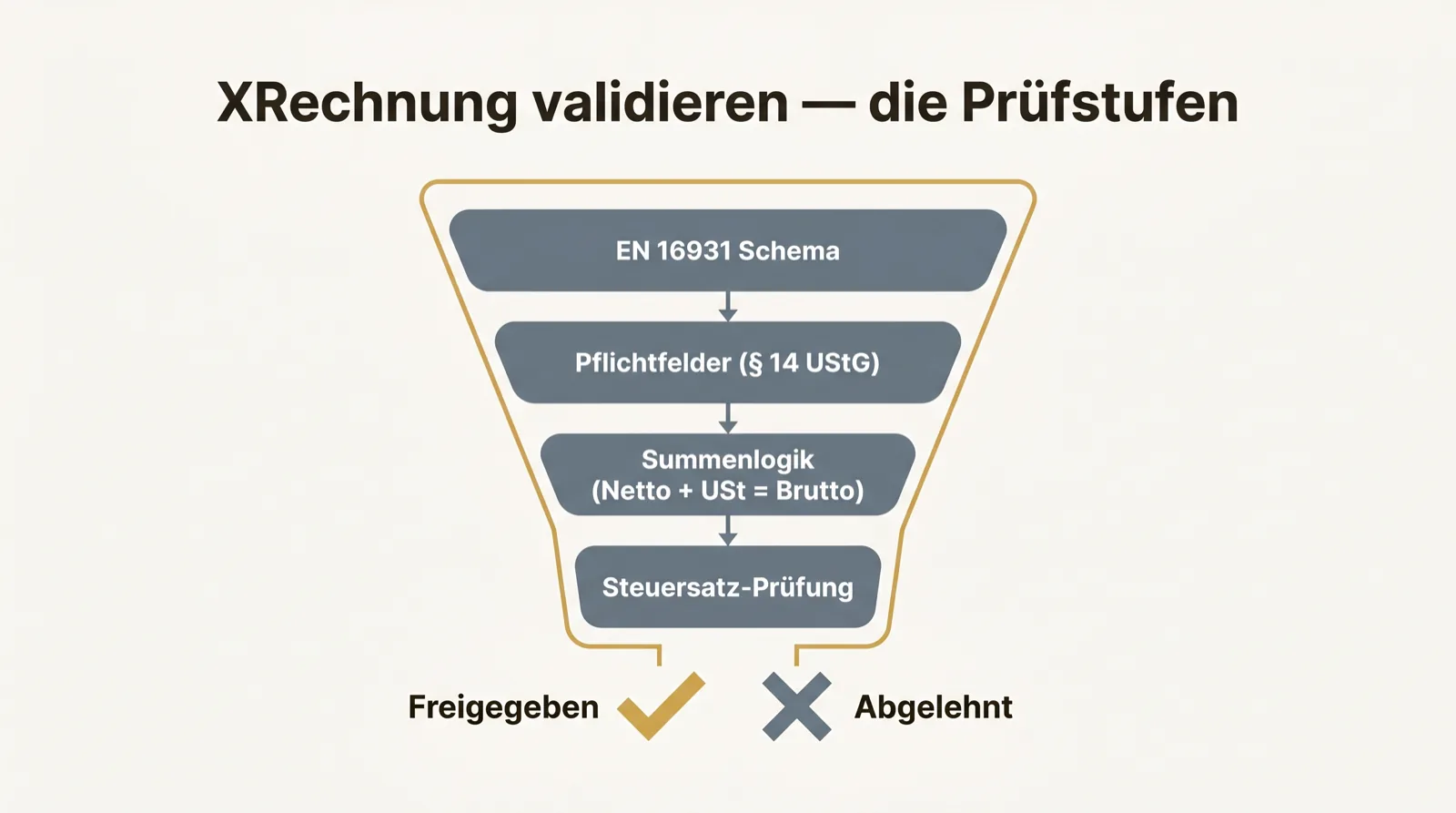
Validating an XRechnung: EN 16931, mandatory fields and typical errors
An XRechnung can look fine and still be formally broken. Validation means: check against the norm before posting. Which stages matter, what EN 16931 requires and which errors appear most often in practice.
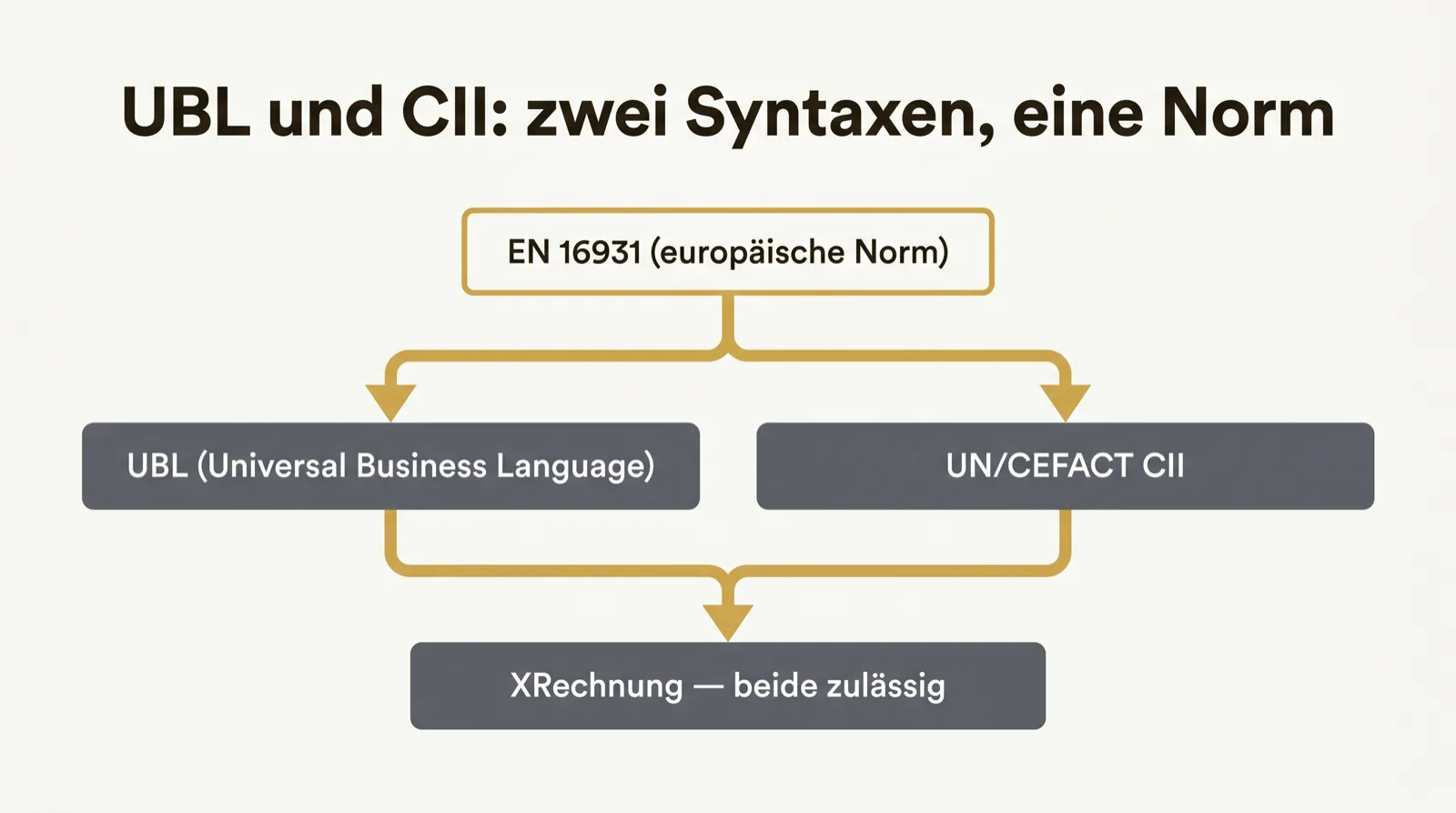
UBL or CII? The technical formats behind the XRechnung, simply explained
UBL, CII, EN 16931 — anyone processing an XRechnung trips over these abbreviations. They sound like deep IT but are understandable in five minutes. And the most important thing up front: as a recipient you hardly have to deal with them.
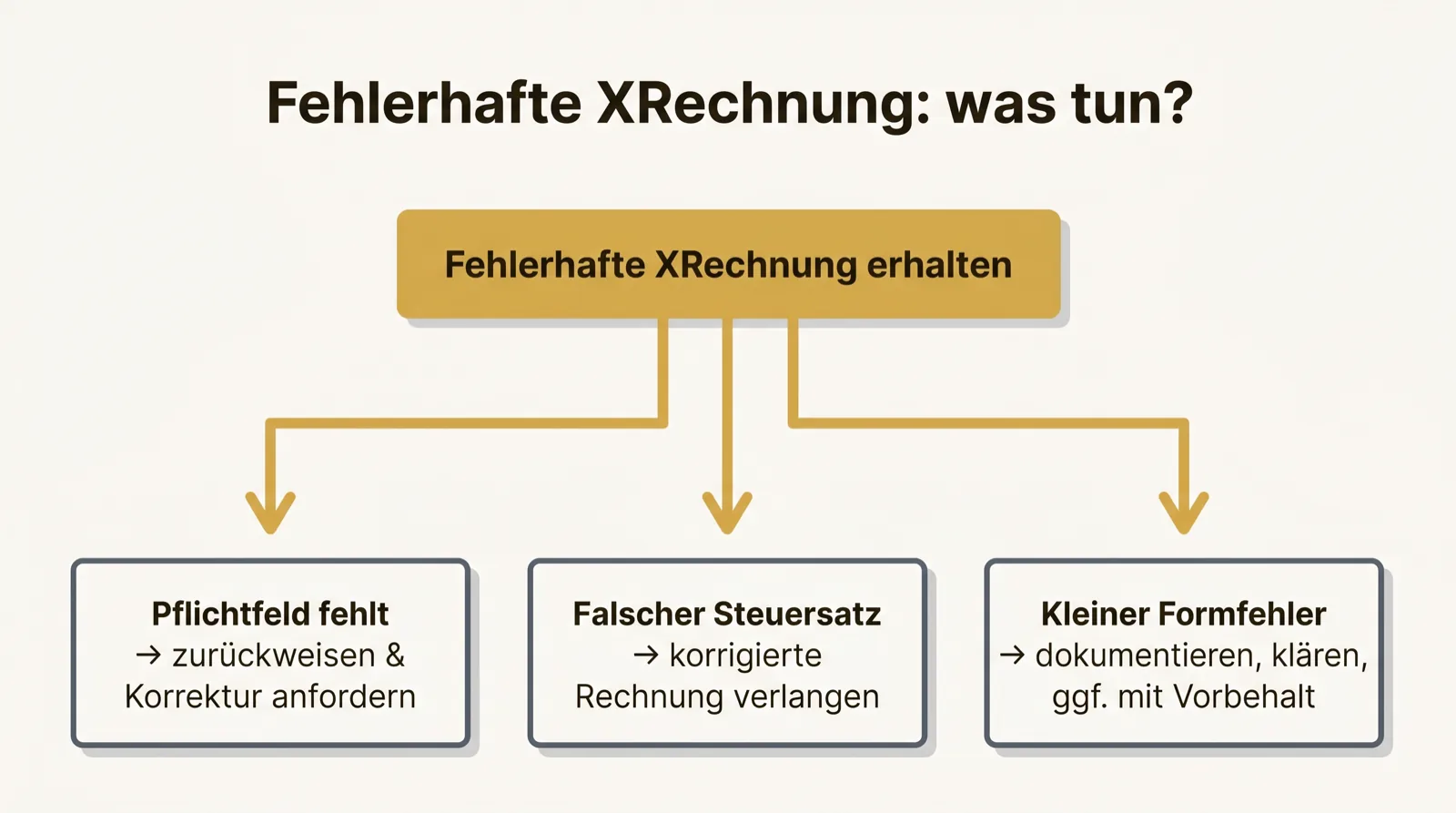
Received a faulty XRechnung: reject, correct or post anyway?
The XRechnung is here, but something is wrong — a mandatory field missing, the tax rate looks wrong, the structure is invalid. Post, ignore or reject? A practical decision aid instead of paragraph anxiety.
Converting an XRechnung to PDF: allowed, but not enough
An XRechnung as a PDF — that seems tidy and familiar. It is also allowed. Only the PDF does not replace the original, and exactly this half-sentence decides whether your filing survives an audit.
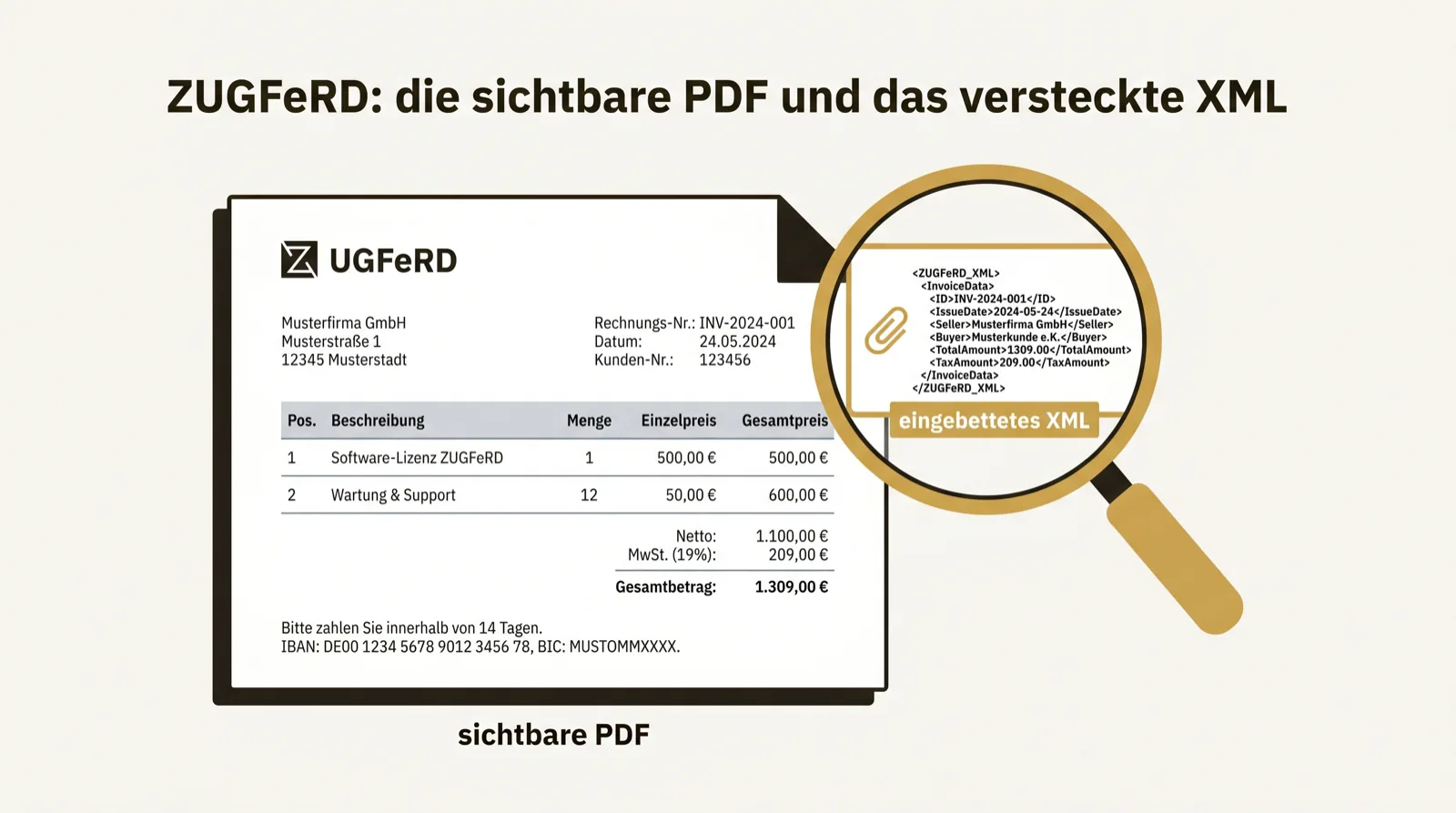
Displaying ZUGFeRD: where is the XML file in the PDF?
A ZUGFeRD invoice looks like a perfectly normal PDF — and that is exactly the half-truth. Hidden in the same document is an XML file. How to find it, display it and why it is the actually important part.
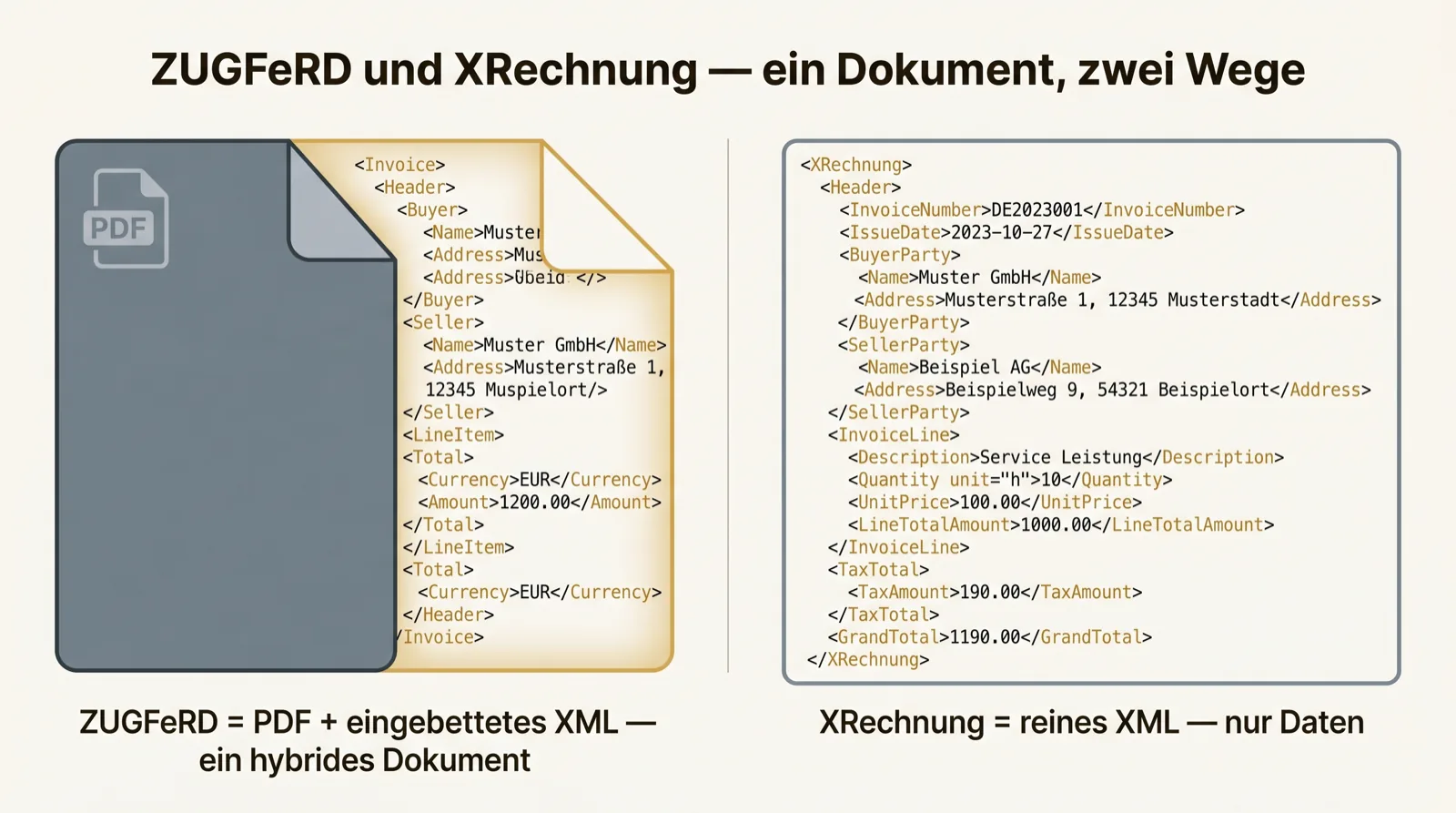
ZUGFeRD vs. XRechnung: which format fits SMEs better?
ZUGFeRD or XRechnung — both are real e-invoices, both meet EN 16931, and yet they feel completely different. For sending the choice can make a difference. For receiving a different rule applies that many overlook. A practical comparison for small and medium businesses.
ZUGFeRD 2.x: why a normal PDF invoice is no longer enough
You have been sending PDF invoices for years and wonder what is different about ZUGFeRD 2.x. The short answer: everything that matters is invisible. What distinguishes the versions and why the visible PDF is only half the invoice.
Factur-X and ZUGFeRD: what German companies should know
Factur-X always shows up when French business partners are involved — and causes confusion. Is it a separate format? Competition to ZUGFeRD? In fact the two are more closely related than the name suggests.
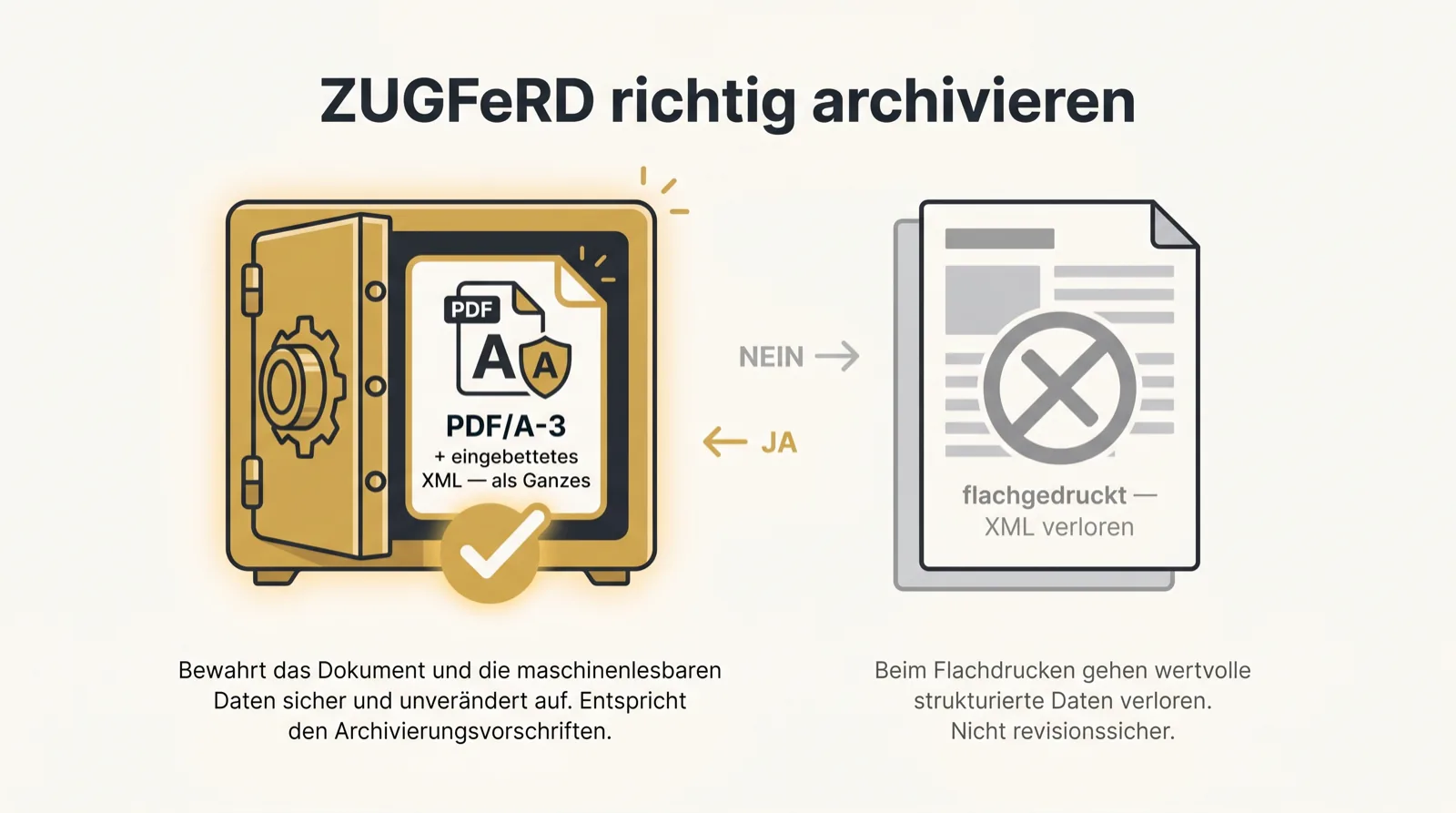
Archiving ZUGFeRD: keeping PDF/A-3 and XML correctly
With ZUGFeRD archiving seems simple: it is “just a PDF” after all. Precisely this thought leads to the most common error. Why with ZUGFeRD the visible page is not the original and how to keep the document correctly.
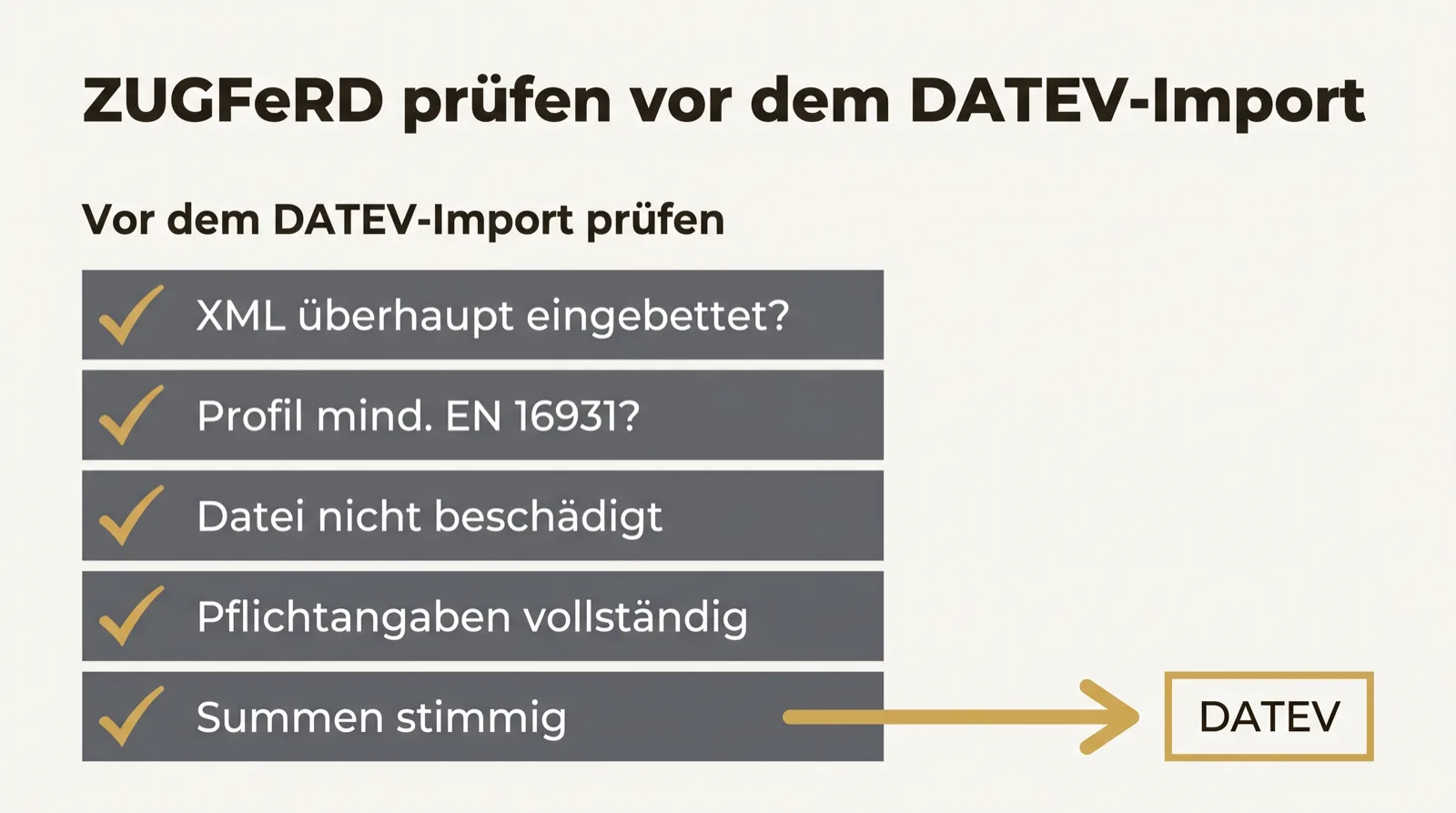
Checking ZUGFeRD: typical errors before the DATEV import
A ZUGFeRD invoice looks fine, the DATEV import fails anyway — or worse, it succeeds with wrong data. What to check before a ZUGFeRD invoice goes into accounting.
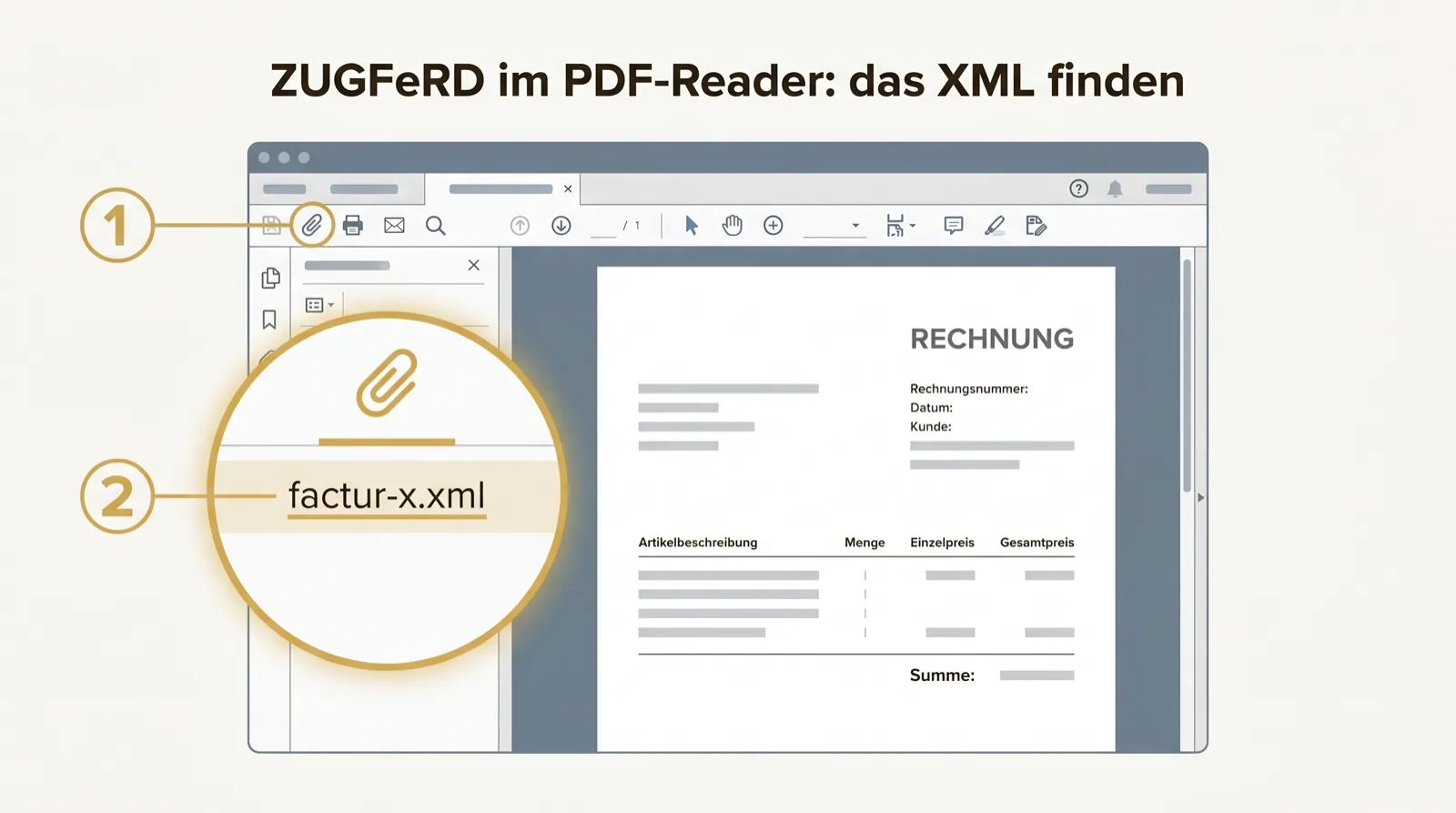
Opening ZUGFeRD in Adobe Reader: a guide for beginners
You just want to check whether a PDF invoice is really a ZUGFeRD invoice? That works with a free PDF reader in under a minute — if you know where to look. A guide without jargon.
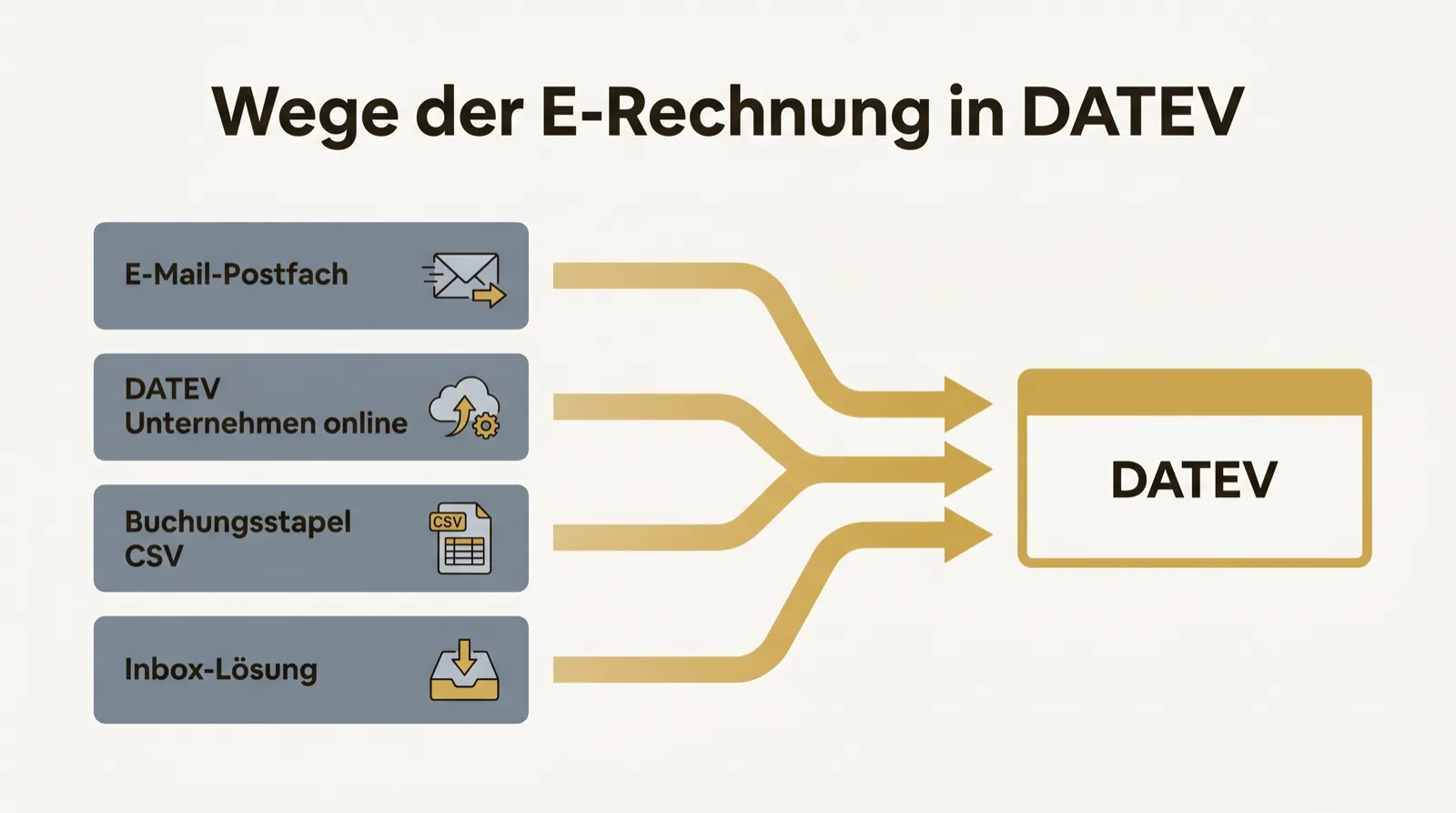
DATEV e-invoice import: routes for clients and firms
This guide explains how structured e-invoices reach DATEV through DATEV Unternehmen online, posting batches, document transfer, an email mailbox, or an upstream invoice intake. It compares the effort and process boundaries for German SMEs and tax advisors, showing when validation, approval, and original archiving should be combined before DATEV without replacing DATEV as the bookkeeping system.
E-invoice for tax advisors: standardize client processes instead of chasing them
Every client does e-invoicing differently — one sends PDFs, the next XRechnung in the mailbox, the third nothing at all. For firms this quickly becomes a search game in the month-end close. How to turn this around with a uniform intake.
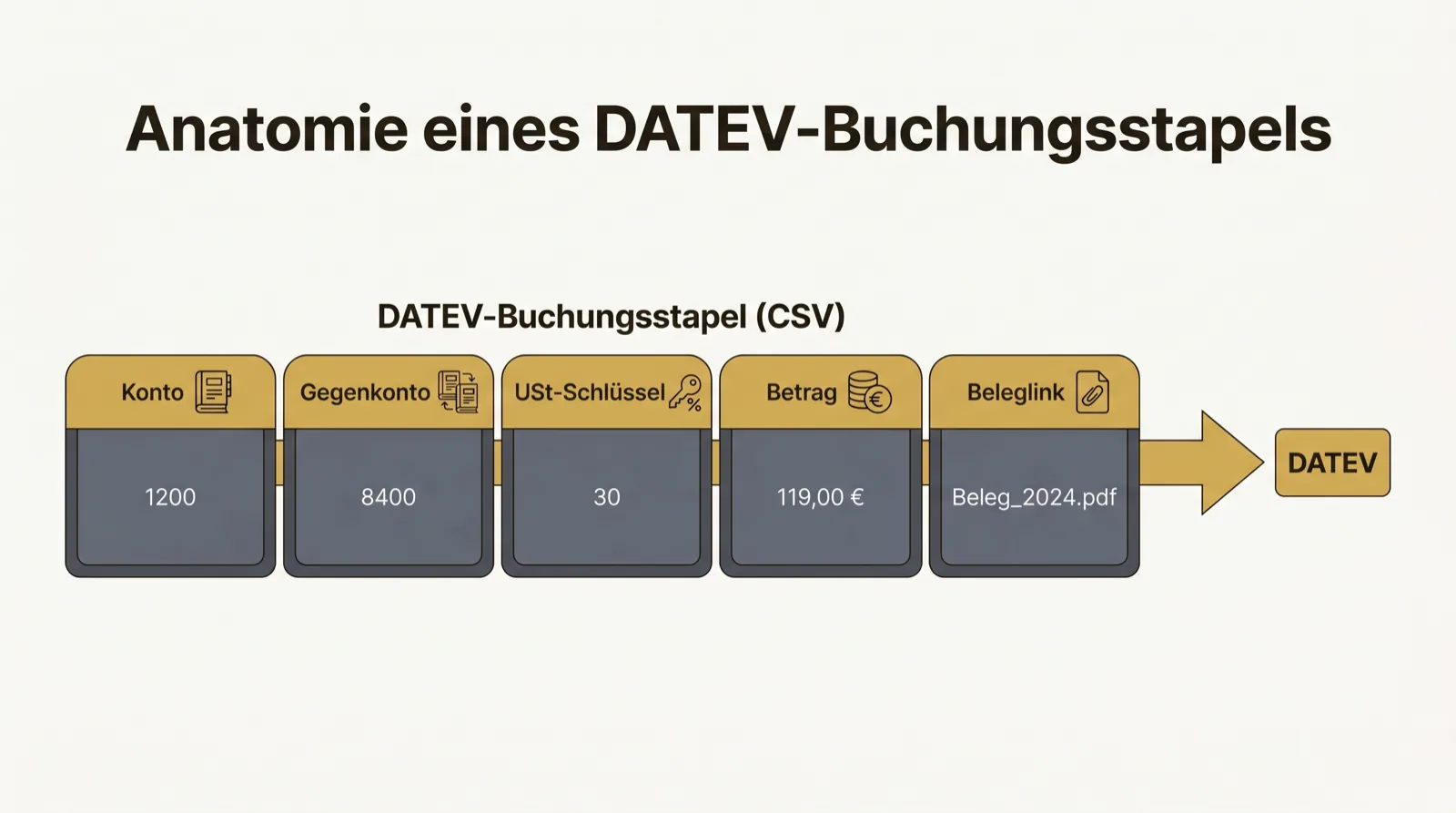
DATEV CSV posting batch: hand e-invoices cleanly to the firm
The posting batch is the bridge between your invoice intake and the firm. Built cleanly it saves both sides days. Built sloppily it only shifts the work. What really belongs in it and where hand-overs fail in practice.
DATEV Unternehmen online and the e-invoice: when is DUO enough, when do you need an inbox?
DATEV Unternehmen online is a given for many clients. The question is not “DUO or not” but: what happens before DUO? That is exactly where it is decided whether the month-end close is calm or hectic.
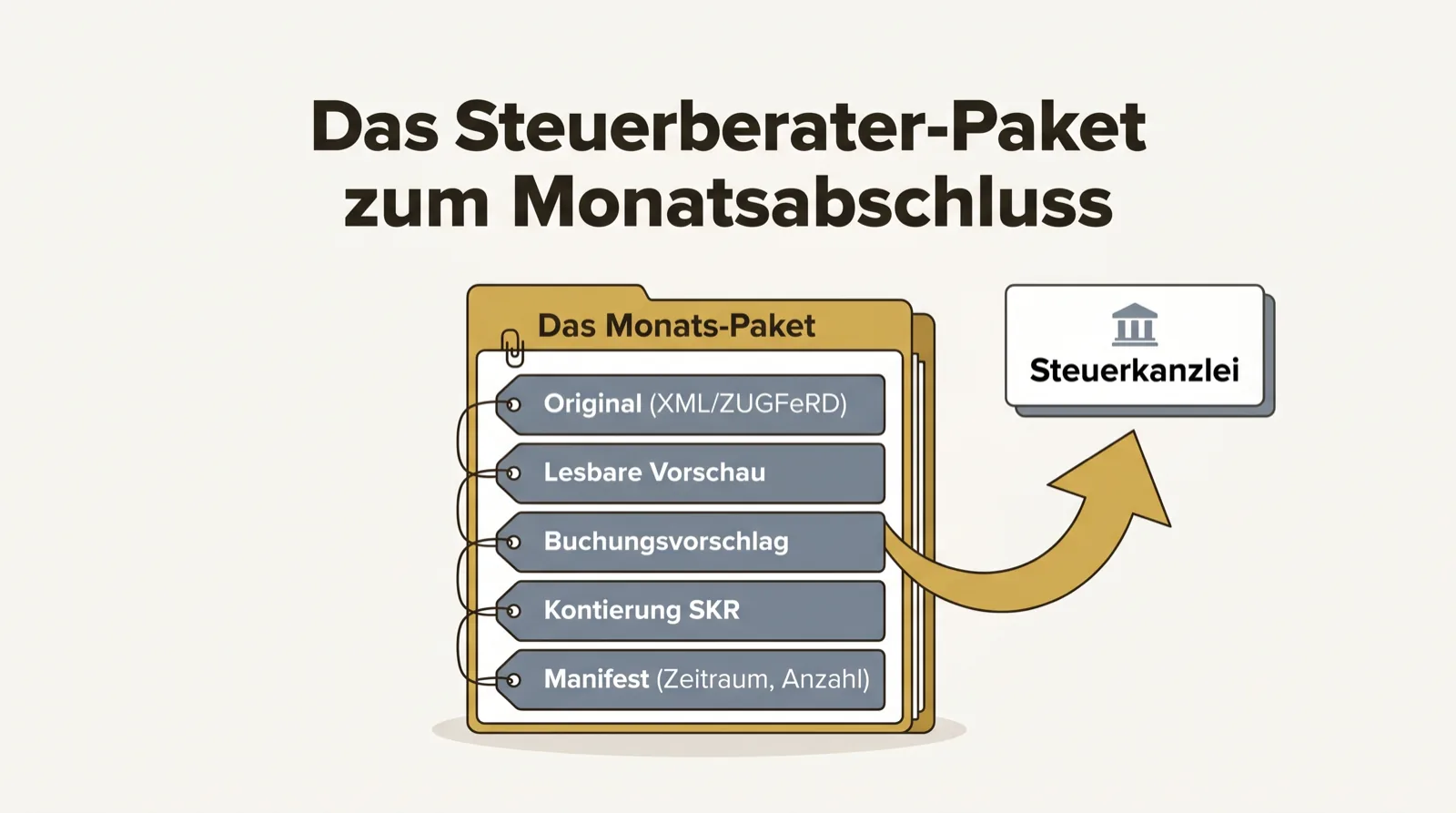
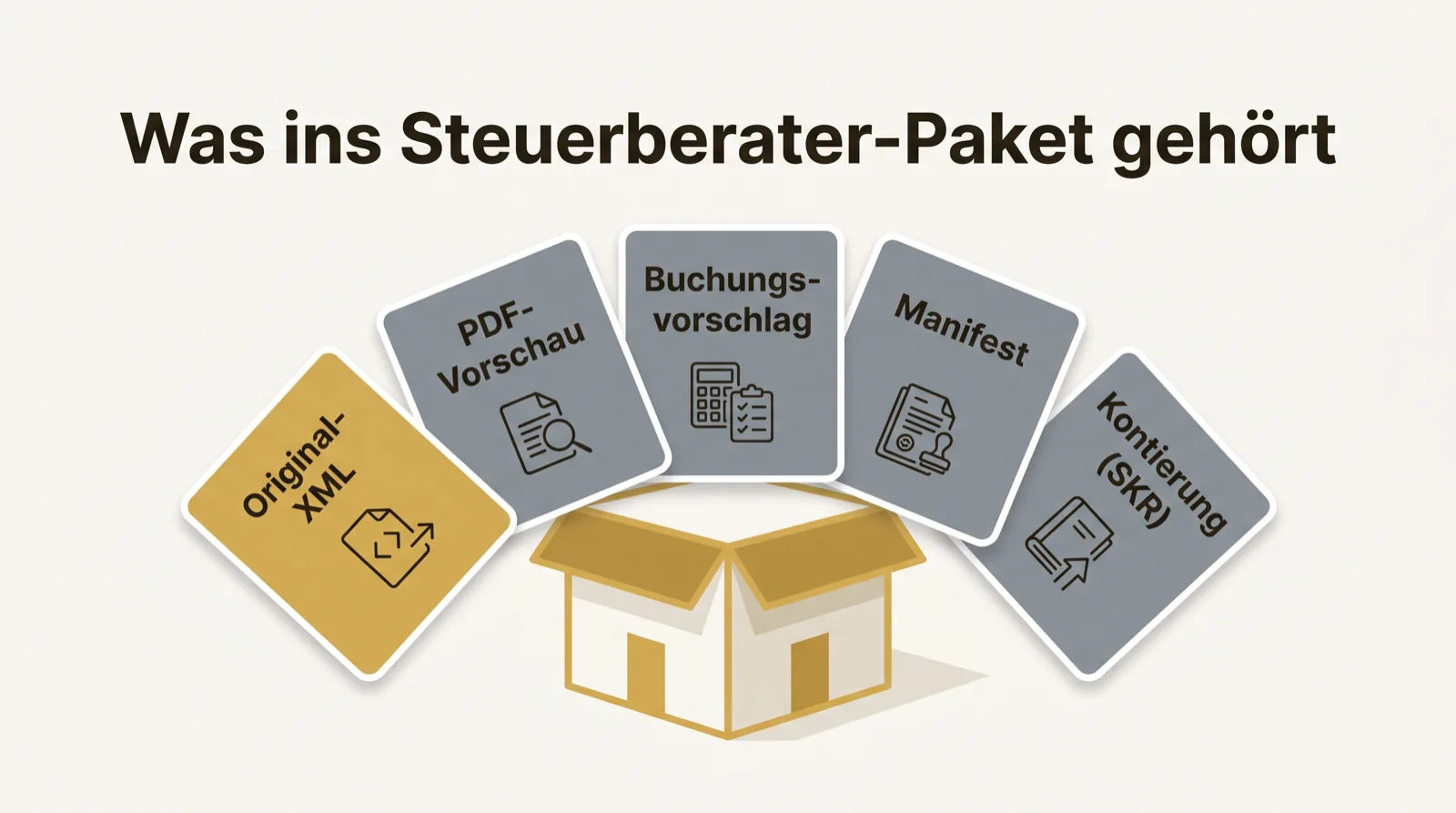
Tax-advisor package for e-invoices: what really belongs in it
Sending a bundle to the firm at month-end sounds simple. Whether it becomes a calm or a tough close is decided solely by the content of the package. What really belongs in it — and what is just ballast.
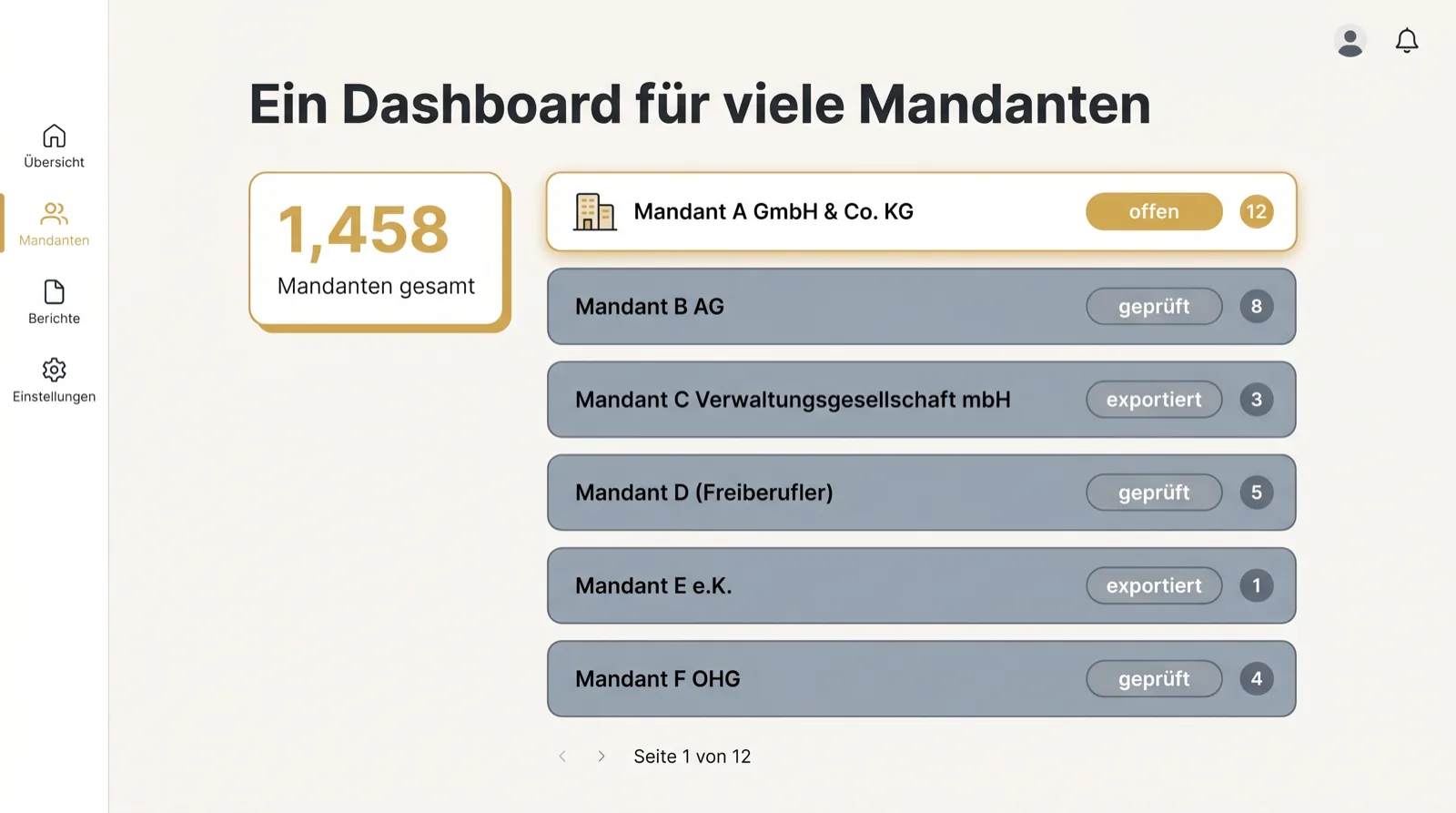
80 clients, 80 mailboxes? How firms bundle e-invoices centrally
Every client a separate mailbox, a separate route, a separate rhythm — and the firm juggles. That does not scale. How a multi-client view turns the search game into a process.
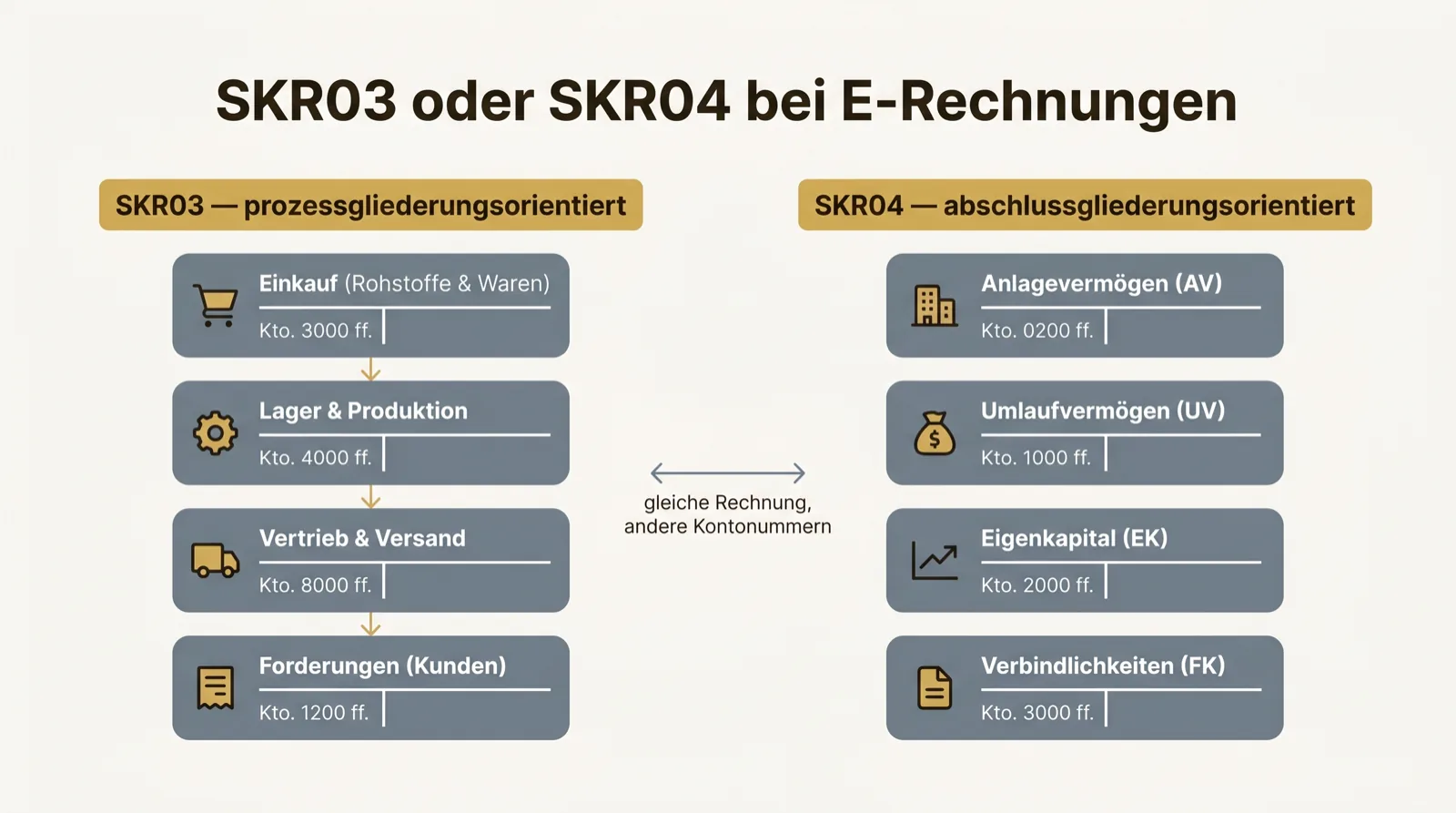
SKR03 and SKR04 with e-invoices: prepare account assignment correctly
An e-invoice delivers structured data — but not your account. The account assignment stays your task, and whether it runs on SKR03 or SKR04 changes the numbers, not the logic. How to prepare the account assignment cleanly before export.
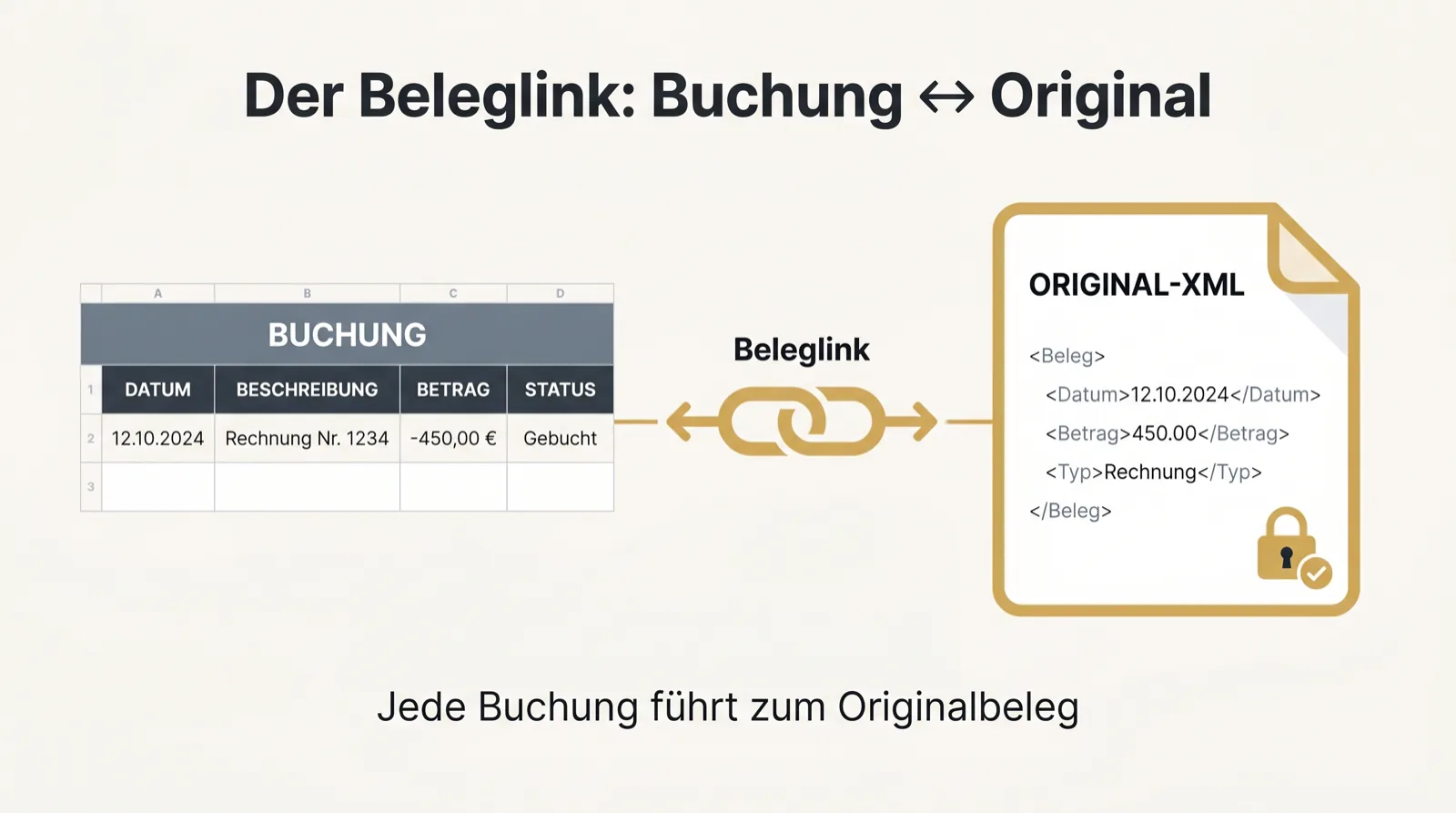
E-invoice and voucher link: why every posting must lead to the original
A posting without a path to the original document is an assertion. The voucher link turns the assertion into evidence. Why this connection matters especially with e-invoices — and makes the difference in a tax audit.
E-invoicing in the trades: how invoice intake works without an ERP
Wholesalers, building-material suppliers, tool shippers — many already send XRechnung. But a trades business rarely has an ERP and rarely someone who sorts invoices all day. How the intake still runs cleanly without turning the workshop into an accounting office.
E-invoicing for SMEs: 7 mistakes to avoid in invoice intake
Most problems with e-invoices are not technical — they are organizational. Seven mistakes keep appearing in small and medium businesses. None of them is complicated. But each costs time, money or nerves later in a tax audit.
E-invoicing for service firms: change processes without rebuilding accounting
Agencies, consultancies, IT service firms: many incoming invoices, no classic warehouse, often no ERP. The e-invoice hits them at a surprising spot — nothing at goods receipt, all the more at invoice intake. How the changeover stays lean.
E-invoicing for clubs and ancillary operations: when the obligation applies
Does a sports club have to receive e-invoices? A non-profit club with a clubhouse? An ancillary operation? The answer depends on whether it acts entrepreneurially — and that is less clear-cut than many think. A classification without a paragraph thicket.
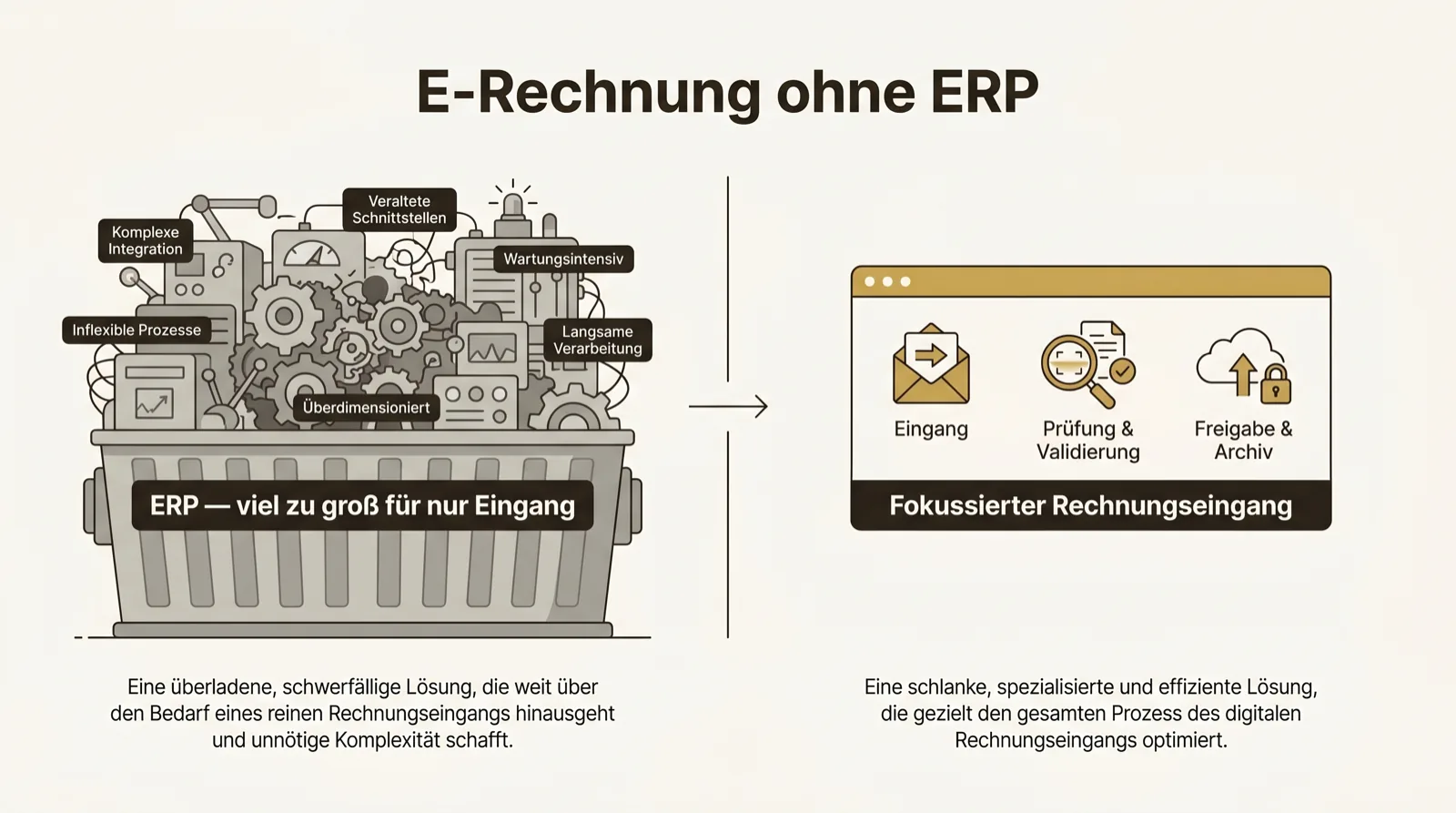
E-invoicing without an ERP: when an inbox solution is entirely enough
The e-invoicing obligation triggers a reflex in many: “now we need a big system.” Mostly that is not true. For receiving a focused tool is enough — and introducing an ERP to accept invoices is often using a sledgehammer to crack a nut.
Introducing the e-invoice without switching your accounting system
“Do we now have to switch accounting?” Almost never. The e-invoice concerns how invoices come in — not necessarily what you post with. How to modernize only the intake and leave tax advisor, DATEV or your software untouched.
Moving suppliers to e-invoicing: a model process for SMEs
You have an orderly invoice intake — but suppliers still send to three different addresses, sometimes PDF, sometimes paper. How to actively steer the inbound side instead of enduring it. A model process that works without pressure.
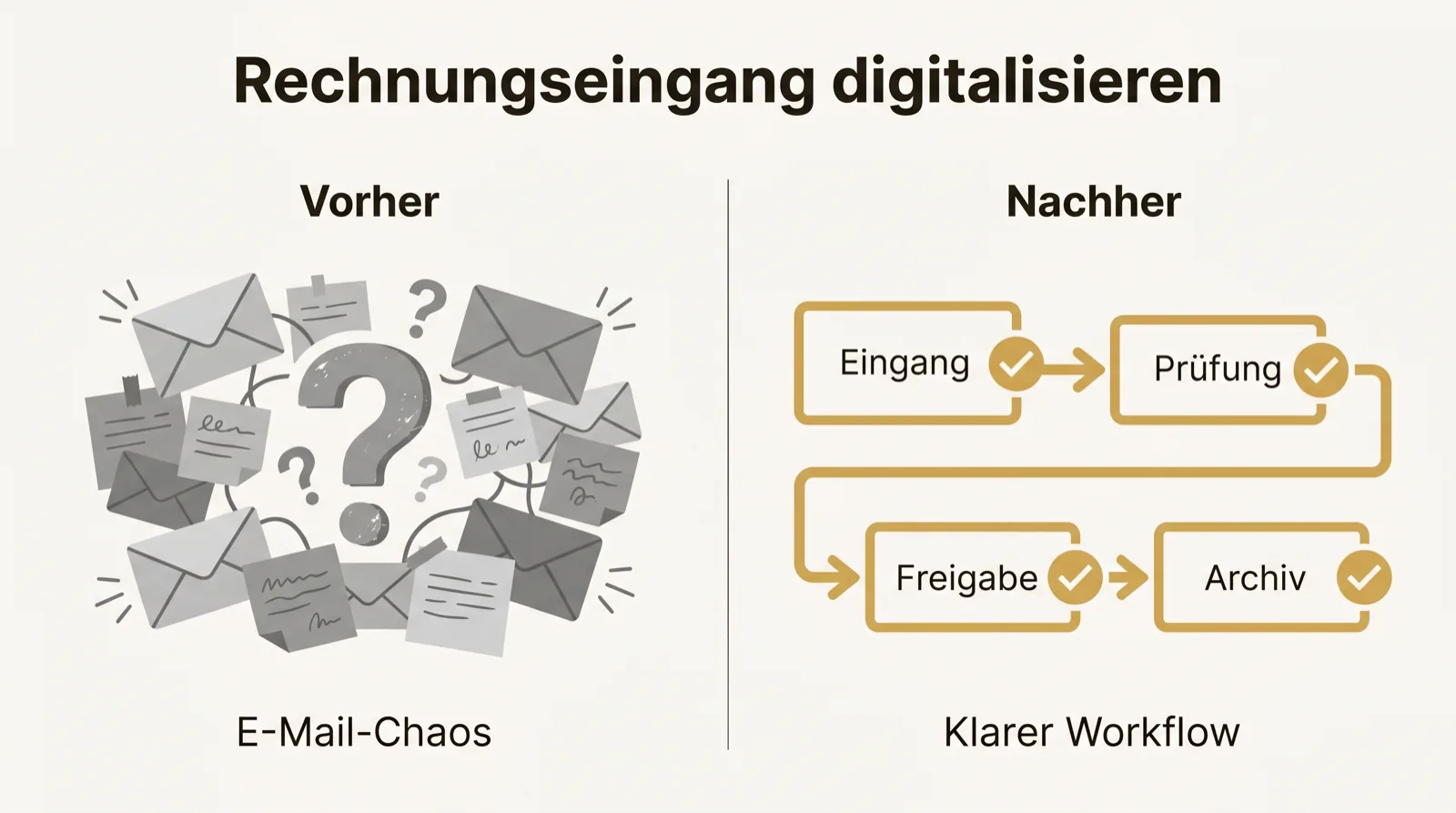
Digitizing invoice intake: from e-mail chaos to clear workflows
Invoices in four mailboxes, a few on paper, some as a photo in a chat — and at month-end someone pieces it all together. Digitizing does not mean “collecting PDFs” but turning this chaos into a workflow. This is what the path looks like.
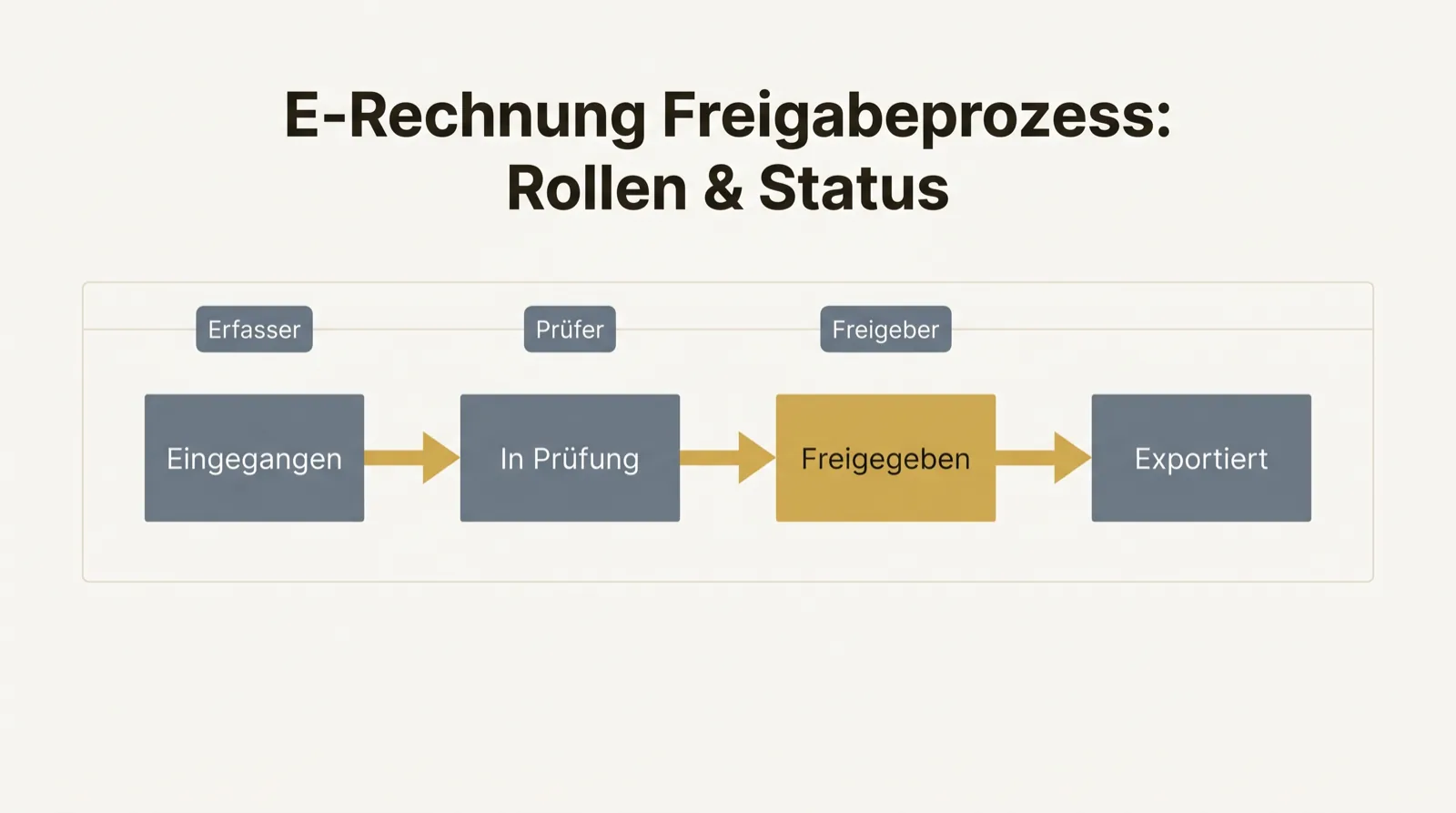
E-invoice approval process: build roles, status and control correctly
Without a clear approval process every invoice becomes a matter of trust: did someone check this? Who approved? With roles and status the gut feeling becomes a traceable flow. How to build it without creating bureaucracy.
E-invoice and month-end close: fewer queries between client and firm
The month-end close is rarely hard at the accounting — it is hard at the queries. “Is something missing?”, “Which account?”, “Where is the original?” Structured e-invoices can shorten exactly this loop. If you set the intake up right.
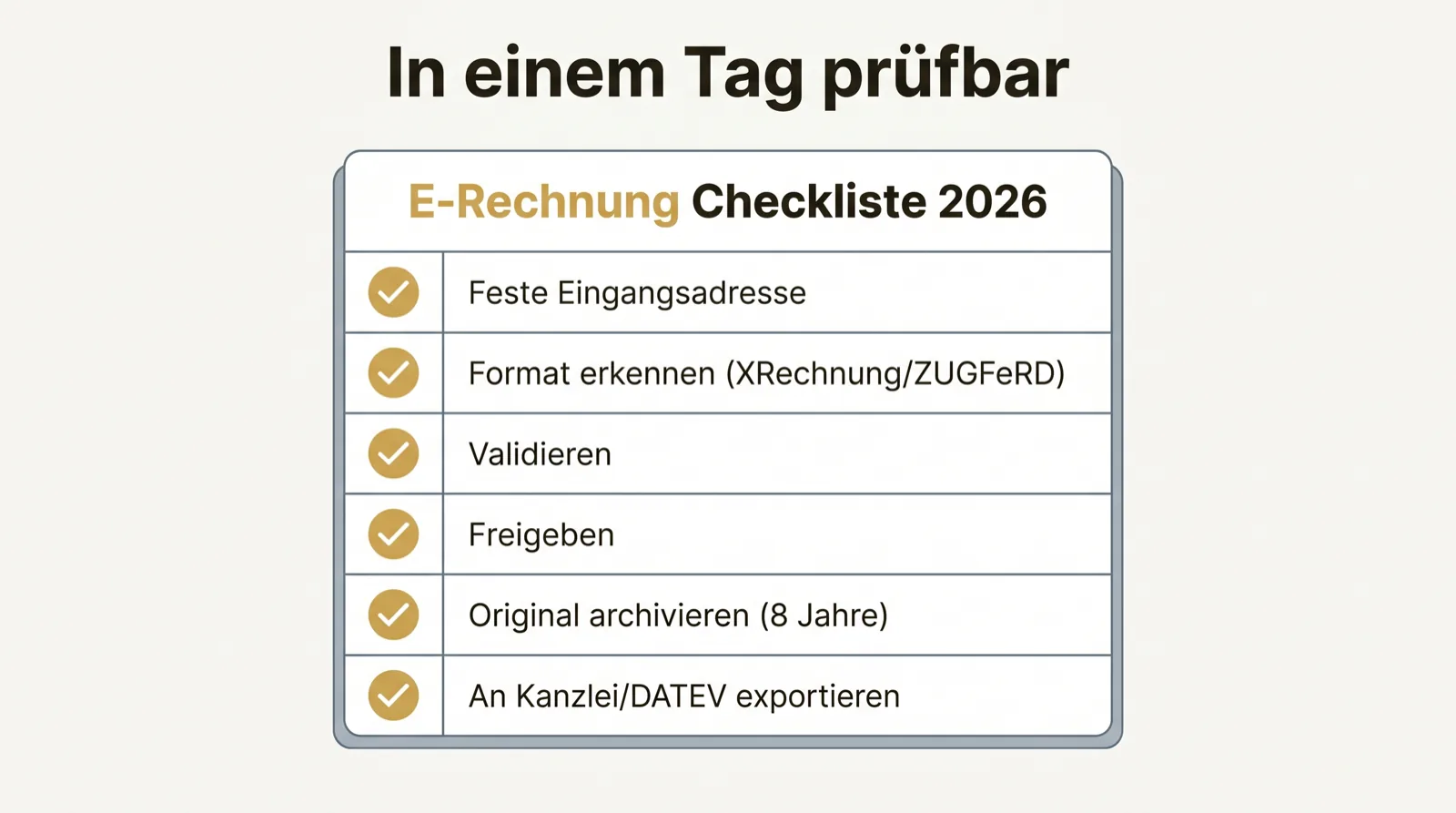
E-invoice checklist 2026: intake, check, archive and DATEV export
No theory, but a list to tick off. This checklist takes you in manageable steps through the e-invoice process — from intake to export. Walkable in a day, permanently useful.
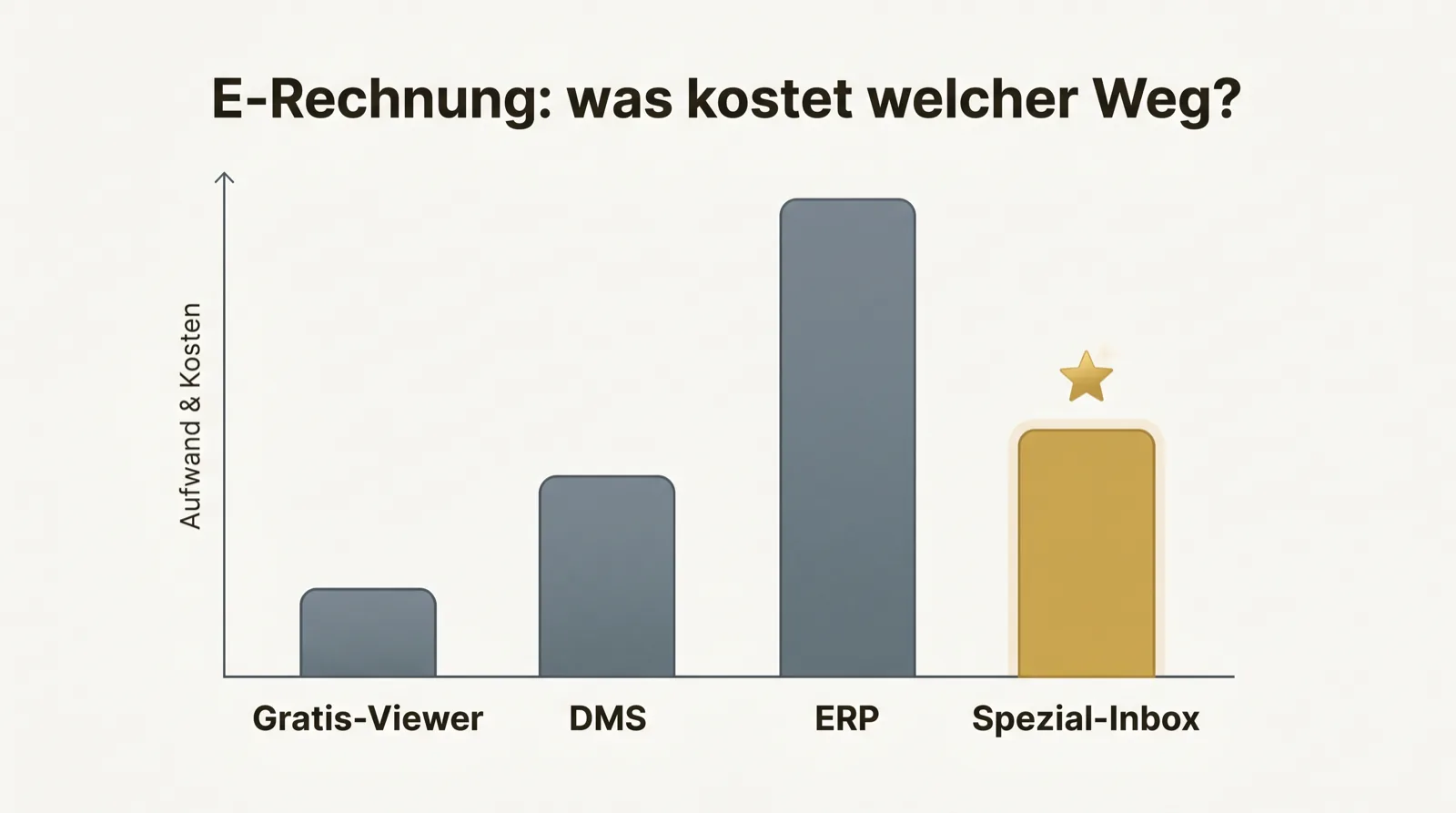
E-invoice cost: comparing viewer, DMS, ERP or specialized inbox
“What does e-invoicing cost?” is the wrong question. The right one is: what does which route cost — including introduction, time and risk? An honest comparison of the four usual routes, without hiding the hidden items.
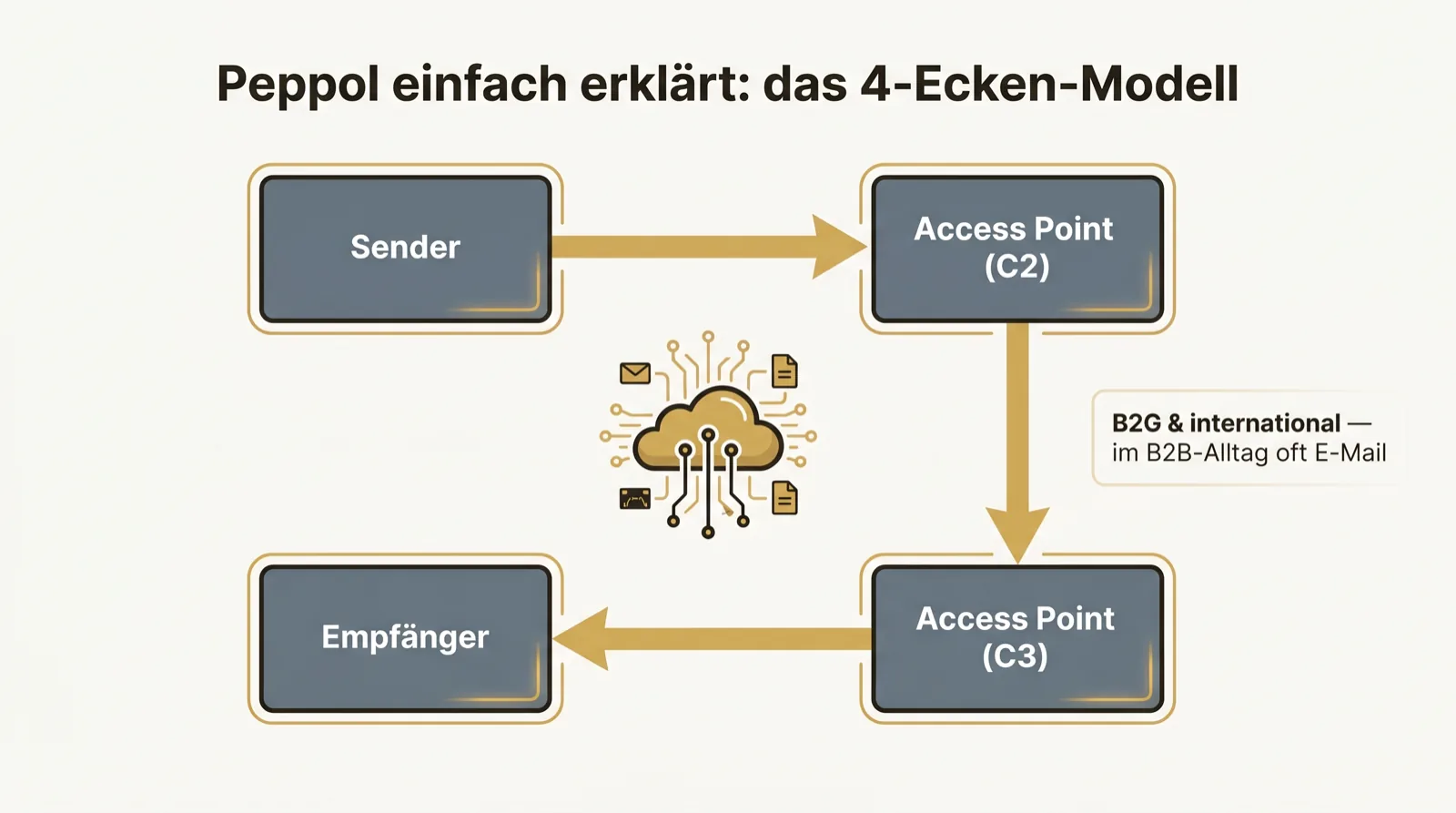
Peppol for SMEs: does your company already need it for e-invoices?
Peppol sounds like obligation and complexity. For most SMEs, though, it is (still) not a must for receiving in everyday B2B. What Peppol is, when it really becomes relevant and why e-mail receiving mostly suffices today.
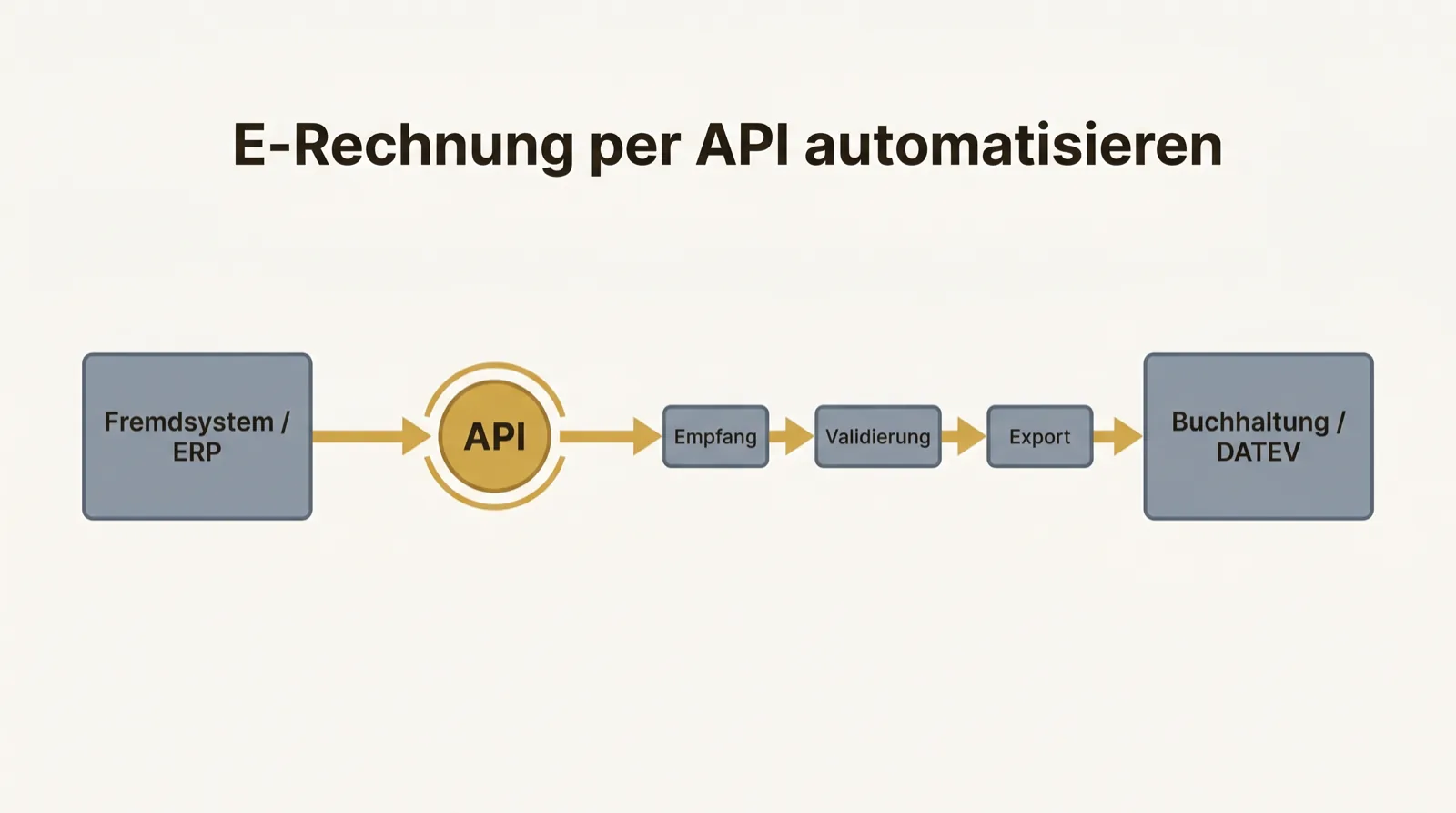
E-invoice API: when automation via interfaces becomes worthwhile
An API sounds like a developer topic — but it is a tangible efficiency question. From when is it worth automating invoice intake, validation and export via an interface instead of working manually? A sober classification.
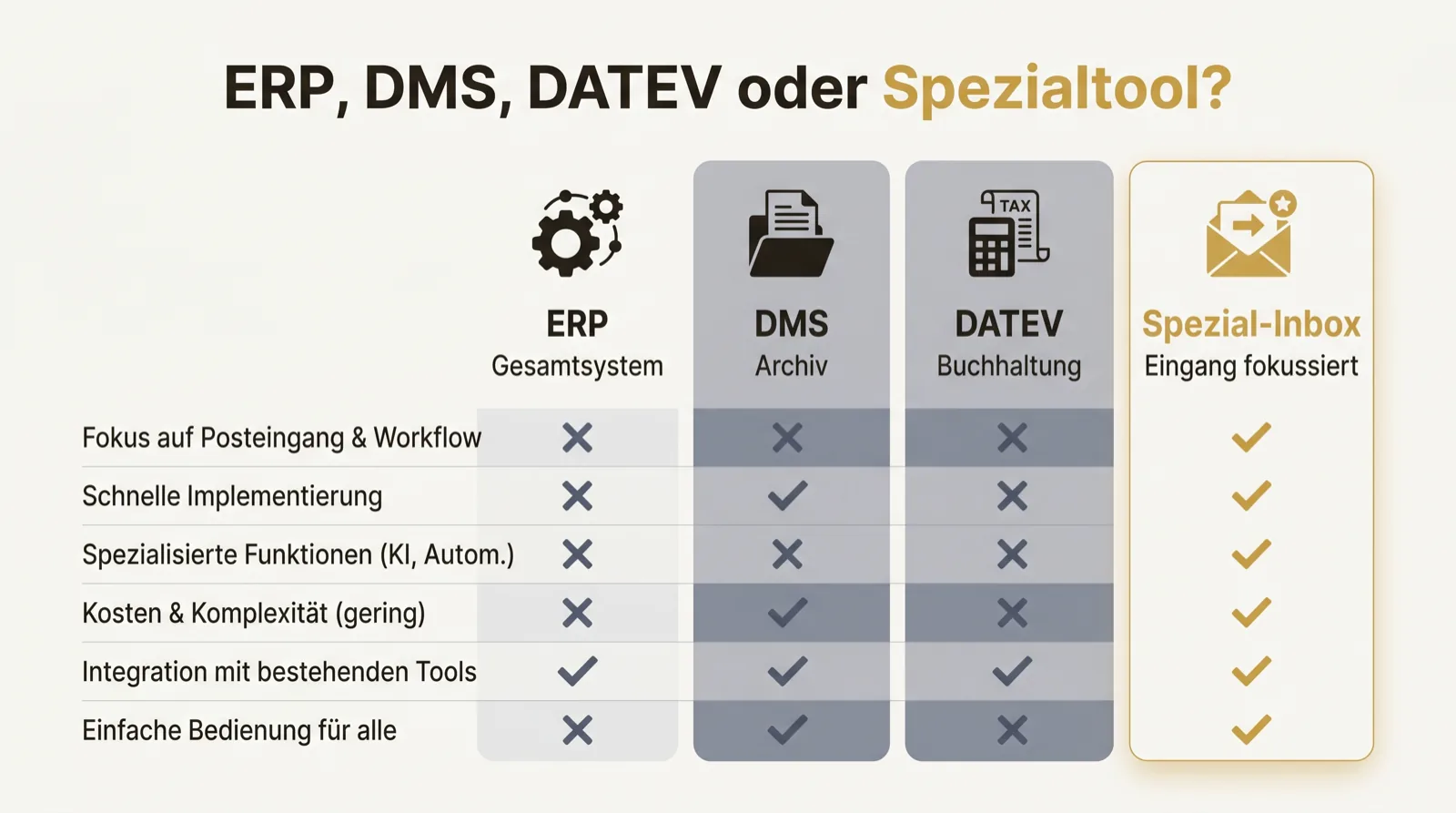
E-invoice software comparison: ERP, DMS, DATEV or a specialized tool?
This e-invoice software comparison classifies ERP, DMS, DATEV, and a specialized inbox for German SMEs and tax advisors. The four tools solve different jobs: company-wide operations, document storage, bookkeeping, or validated invoice intake. A decision matrix shows when an existing system is enough and when an upstream inbox closes the gap between receipt, validation, archiving, and handoff.
Your supplier is switching to e-invoicing — what you need to do now
A supplier writes to say that from now on it will only send electronic invoices, often with a transition window of a few months. This guide answers the three questions that follow: what exactly is being asked of you, by when, and why an ordinary email inbox only appears to meet the requirement.
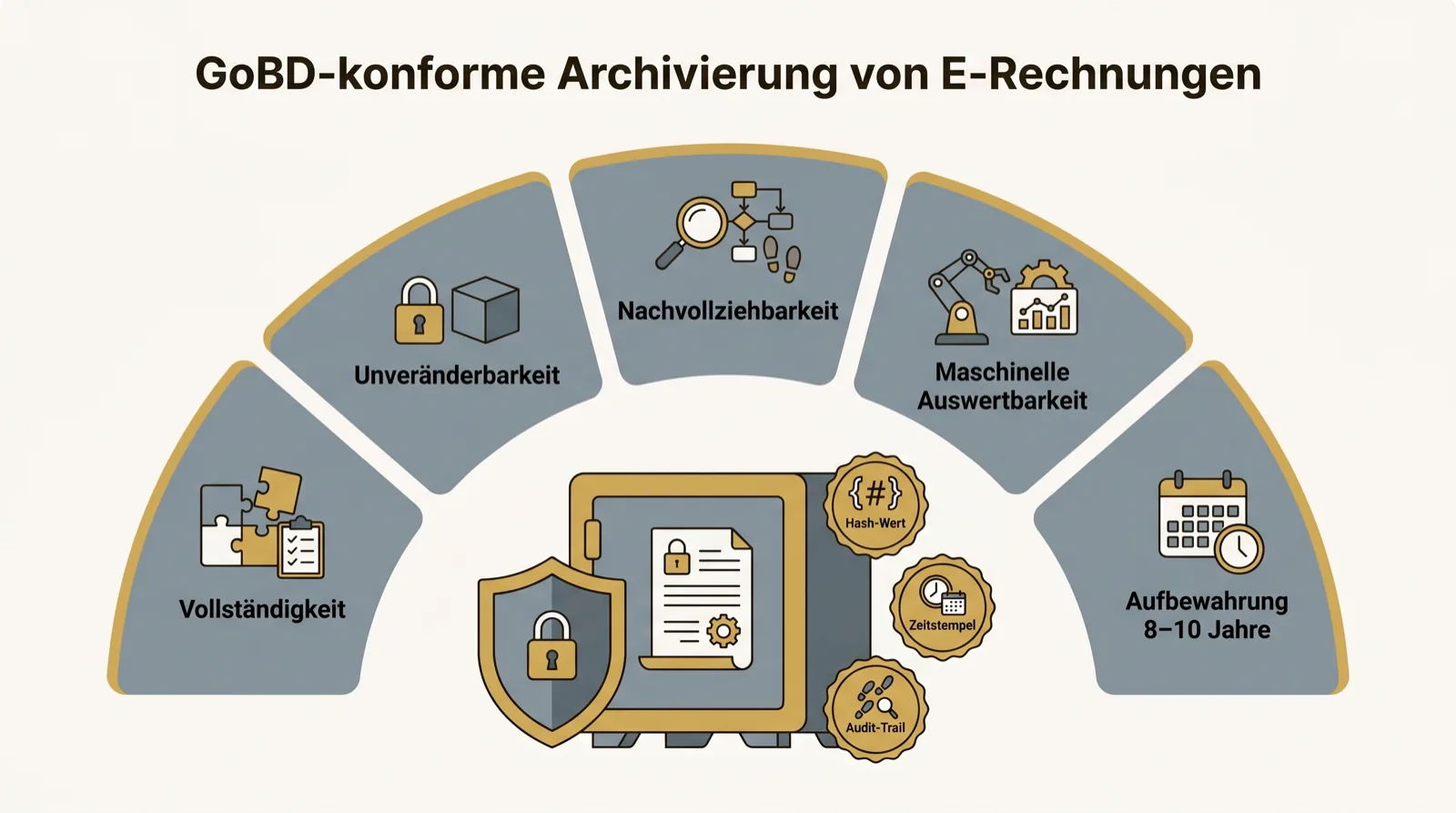
GoBD archiving for e-invoices: requirements explained clearly
“GoBD-compliant” is on every second software page. Almost none explains what is behind it. Yet the basic requirements are surprisingly tangible — and especially relevant for e-invoices because the machine-readable original is quickly lost. Here the GoBD without officialese, with a practical check at the end.
Keeping e-invoices for 8 years: what really belongs in the archive?
Eight years sounds long — and that is exactly why the error becomes visible so late. What you really must keep of an e-invoice, when the period starts and why “we have the PDF” is no good answer in year seven.
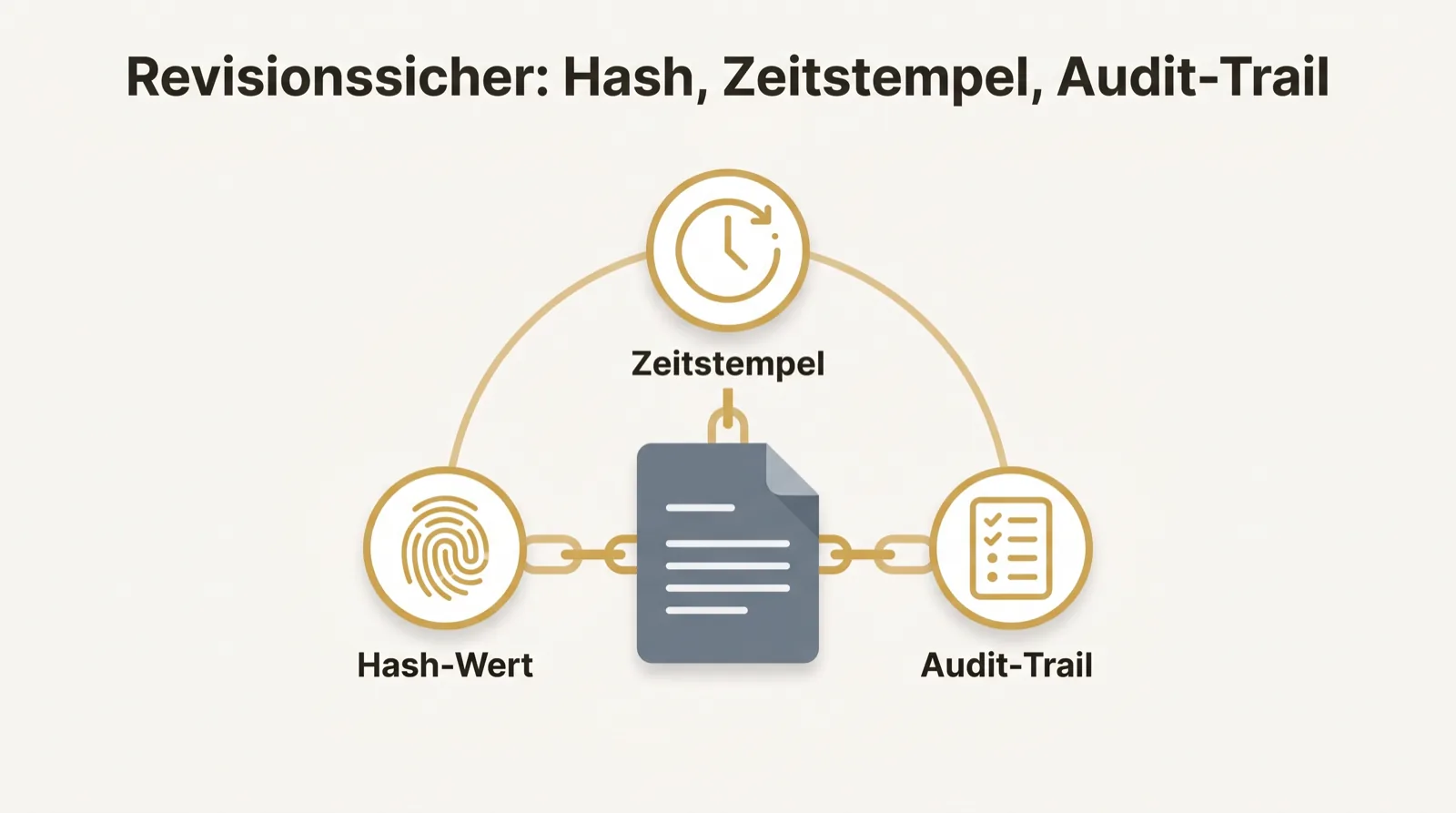
Archiving audit-proof: hash, timestamp and audit trail for e-invoices
“Audit-proof” is everywhere, rarely explained. Behind it are three sober technical building blocks: hash, timestamp, audit trail. What they mean — without a cryptography lecture — and why they make the difference with e-invoices.
GDPR and the e-invoice: what to watch with cloud hosting
Invoice data are often also personal data — names, contact details, bank accounts. Whoever processes e-invoices in the cloud is thereby right in the middle of the GDPR. What matters, without panic and without legalese.
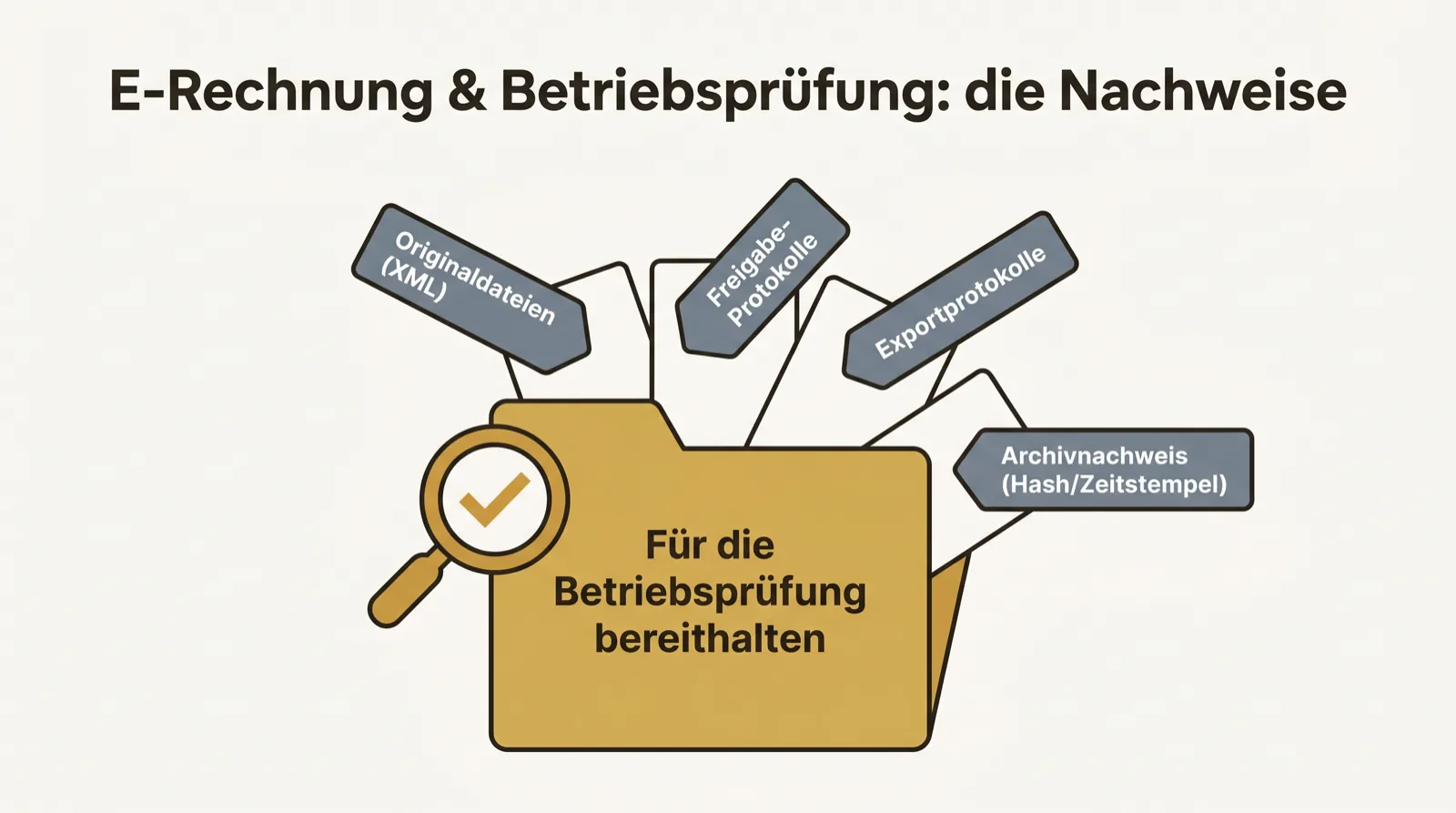
E-invoice and the tax audit: which evidence becomes important
The tax audit asks differently with e-invoices than before — more targeted, more technical, for the structured original. Which evidence you should keep ready so a routine audit does not become a search game.
Checking the VAT ID in invoice intake: more safety with supplier data
A wrong or invented VAT ID often only surfaces when it gets expensive. A plausibility check already at invoice intake is no bureaucratic end in itself — it protects input-VAT deduction and master-data quality. What is sensible and what is overkill.