Multi-client cockpit
One interface for 40–80 clients: dedicated inbox address, search and filtering, metrics, and client detail pages with open review cases and export readiness.
Review open questions and approvals; clients prepare eligible e-invoices as a package for your practice.
Firm plan €49/month flat, plus VAT · Each client books its own plan from €9.99 · Businesses only (Section 14 BGB)
 Illustrative scene · AI-generated
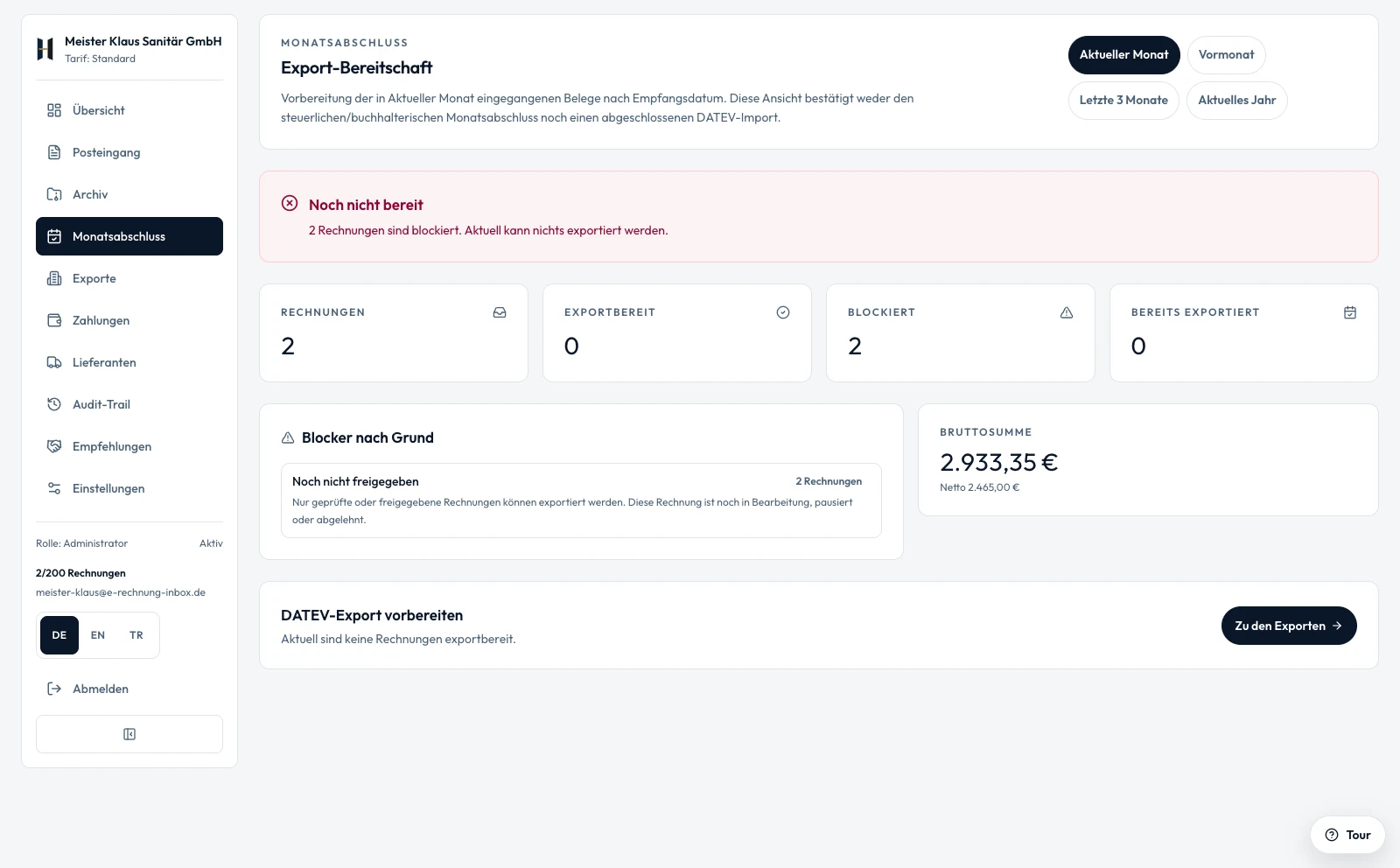
In the firm cockpit (activated after review) you see status, follow-ups and export readiness of all connected clients; each client company has its own inbox. The default workflow stays client-led: the client exports the tax-advisor package ZIP and sends it to you. Direct transfer to DATEV Unternehmen online is in preparation; DATEV's technical review is still pending.
Forwarding PDFs by email. Sorting receipts chronologically. Typing DATEV batches by hand. A separate folder for every client. With 40–80 clients this becomes weekly search and follow-up time you cannot bill.
From 1 January 2027, clients with more than EUR 800,000 total turnover in the prior year must issue e-invoices in domestic B2B (§ 27 (38) UStG); for all others the transition rule runs until the end of 2027. At the same time every client receives more structured incoming invoices, because their larger suppliers switch over. For the firm this means: check thresholds, review incoming invoices, standardise hand-overs.
Check the threshold per client: 2026 total turnover under § 19 (2) UStG — clients above it issue invoices after 31 December 2026 as e-invoices, including for supplies made in 2026.
Review incoming invoices: from 2027 a paper or PDF invoice in domestic B2B is only a proper invoice if an exception or transition rule applies to the supplier (UStAE section 15.2a (1)).
Standardise the hand-over: every client company gets its own inbox; XML originals are validated, kept unchanged and reach the firm as DATEV CSV or the tax-adviser package.
One interface for 40–80 clients: dedicated inbox address, search and filtering, metrics, and client detail pages with open review cases and export readiness.
SKR03/SKR04, advisor number, client number, fiscal-year start and default creditor are maintained per client so exports do not need to be rebuilt inside the firm.
Account labels and DebKred_Stamm are imported and reviewed per client. Creditor suggestions are manually confirmed before every assignment; no creditor is created automatically.
Supplier and expense accounts are stored per client and supplier and included in available file exports. Changes remain visible in the history.
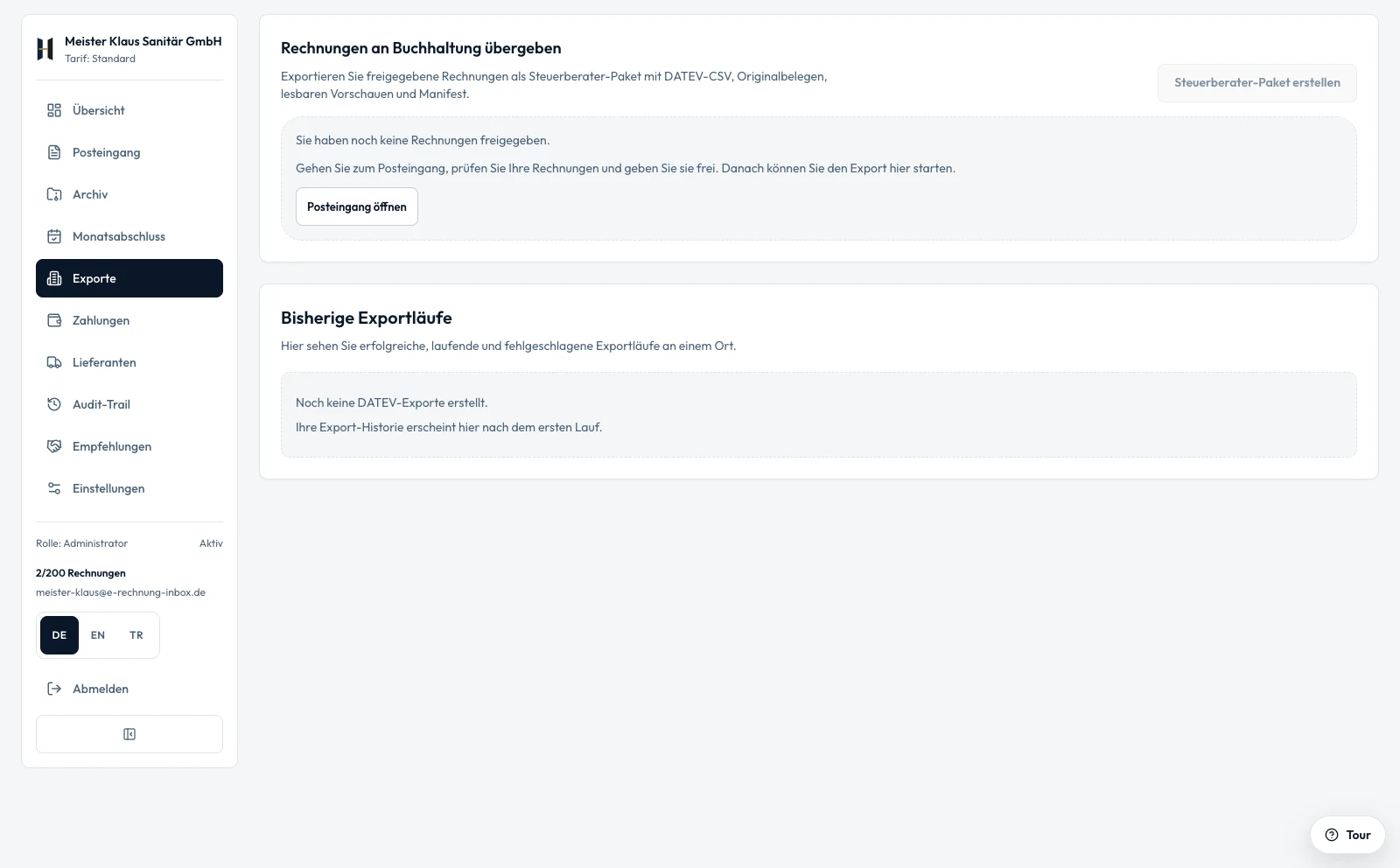
The default handoff without a firm login: clients export a ZIP with DATEV CSV, originals, readable previews, manifest, booking suggestions and README, then send it to the advisor.
CSV posting batches per client, original files and audit trail stay separated. Direct DATEV transfer remains clearly marked as beta until production approval is active.
Every client carries a health score (Healthy / Needs attention / At risk) with its top reason in the cockpit; the list sorts the clients that need attention to the top. Computed deterministically from open backlog and access state — explainable, no AI.
Review previously observed IBANs and recurring findings per supplier. Check changed bank details yourself; the display does not verify account ownership.
For each invoice a GoBD-oriented evidence pack: invoice identity, file provenance with SHA-256 checksum, validation result, processing and export timeline, the audit trail and a retention summary — as Markdown or as a ZIP with the original file, with no data changes.
 Illustrative scene · AI-generated
€49/month firm plan plus VAT; annual commitment -15%, 2-year commitment -30%; clients book their own plan
A single interface for 40–80 clients — instead of dozens of email folders
Firm cockpit included in the Kanzlei plan, personal invitation link, client overview
DATEV master data, account labels and reviewed DebKred_Stamm suggestions per client
Supplier-level coding with immutable audit trail instead of manual follow-up work
Tax-advisor package ZIP with DATEV CSV, originals, previews, manifest, booking suggestions and README
Original storage is available during active membership. After the paid period or free trial ends, customers have one month (30 days) to export their documents and then retain them under their own responsibility.
Client health: an explainable health score sorts what needs attention to the top — no AI
IBAN watch per supplier: a warning on changed bank details, before payment
Prüfungsmappe per invoice: a GoBD-oriented evidence pack with SHA-256 checksum for the audit
Firm access for 40–80 clients — 14-day free trial, no credit card. €49/month firm plan plus 19% VAT, with optional annual or 2-year commitment; clients book their own plan. Offer exclusively for businesses within the meaning of Section 14 of the German Civil Code (BGB).
The photographic work scenes are AI-generated illustrations, not depictions of actual customers. The product views show the real application with sample data. DATEV is a registered trademark of DATEV eG; mentioning it does not imply approval of this product.
This website uses cookies to improve your experience and analyze traffic. You can decline individual categories at any time. Privacy Policy