Intake: does everything even arrive?
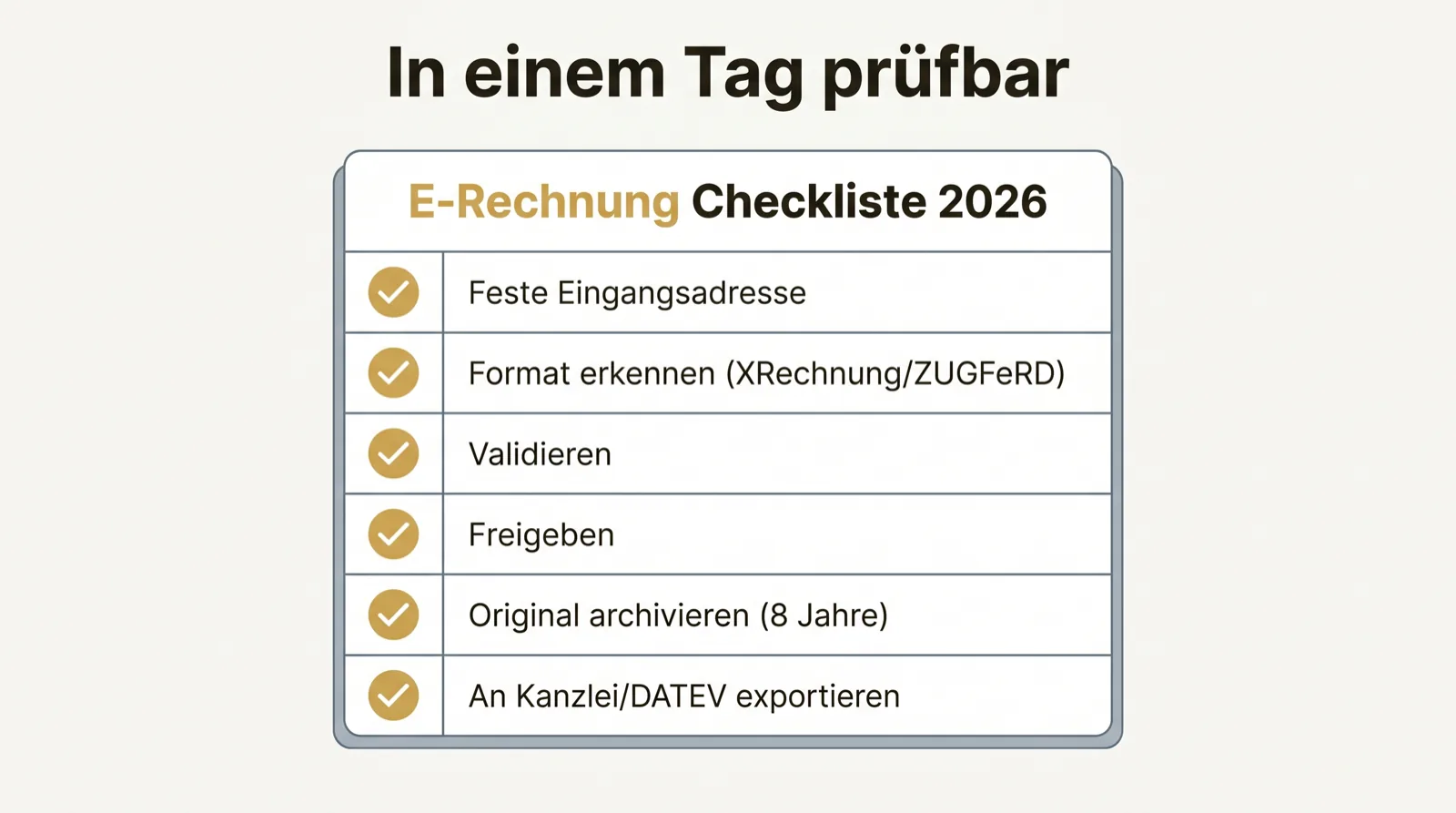
The first block clarifies the basics. Is there a fixed, dedicated invoice address? Do the suppliers know about it? Are incoming .xml and ZUGFeRD files reliably accepted, not swallowed in the collective mailbox?
If something is stuck here, the rest is of little use — the intake is the foundation.
Receive e-invoices · Check an e-invoice for free
Check: is the invoice valid?
The second block concerns quality. Is the format detected? Is it validated against the norm? Are mandatory details and totals checked before approval?
An invoice that runs through unchecked is a later correction. This block prevents exactly that.
Approval: do you know who decided?
Block three: are there clear roles and statuses? Is it documented who approved when? Is there a value limit for a second control?
Approval without a trail is worthless in an audit. Here the shout becomes evidence.
Archive: does the original lie safely?
Block four is the one that most often fails. Is the structured original kept, not just a PDF? Unalterable, timestamped, outside the mailbox? Retrievable over eight years?
That is the question the tax audit asks most precisely — and to which many have no good answer.
Export: does it arrive cleanly at the firm?
Block five closes the loop. Is there a defined hand-over route to DATEV or the tax advisor? With voucher link, posting proposal, manifest? Uniform every month?
If all five blocks have a tick, your process is not perfect — but it survives an audit and a month-end close without drama.
- Fixed intake address, suppliers informed.
- Format detected and validated against the norm.
- Roles, status and documented approval.
- Structured original audit-proof, 8 years.
- Defined export to firm/DATEV with voucher link.