The quiet obligation many underestimate
There is a lot of talk about sending e-invoices. About receiving, hardly any. Yet receiving has been mandatory for practically every business in Germany since 1 January 2025 — no transition period, no choice.
The rule sits in the newly worded § 14 UStG, introduced by the Growth Opportunities Act. Anyone active in domestic B2B must be able to accept and process an e-invoice. The recipient's consent is no longer required. The supplier may send an XRechnung, and you must be able to handle it. Full stop.
The Federal Ministry of Finance set out the details in its letter of 15 October 2024. Whoever still says in 2026 “we'll sort it out later” already has the problem.
What an e-invoice technically really is
An e-invoice in the legal sense is not a PDF. It is a structured data set under the European norm EN 16931. Two formats are common in Germany: the XRechnung, a pure XML file, and ZUGFeRD, a PDF with embedded XML.
The difference is not cosmetic. A PDF is made for the human eye. An e-invoice is made for the machine — it carries every field unambiguously labelled: invoice number, service date, tax rates, bank details. That is precisely why software can check and post it automatically.
A scanned paper, a photographed receipt, a nicely designed PDF from the web shop: under the new definition all of that remains an “other invoice”. Not an e-invoice.
The most common error: “we do have a mailbox”
True — and legally an e-mail mailbox is even sufficient as an access route. The law does not require a Peppol connection. And yet this is exactly where practice fails.
An XRechnung arrives as a cryptic .xml file in the attachment. In an inbox between newsletters and appointment confirmations it is overlooked, forwarded, deleted or ignored as a “weird file”. Nobody checks it systematically. Nobody knows for sure whether it even arrived. And in a tax audit it is precisely the machine-readable original that is missing.
A shared collective mailbox is not an inbound process. It is a risk with a timestamp.
The five stations of a received e-invoice
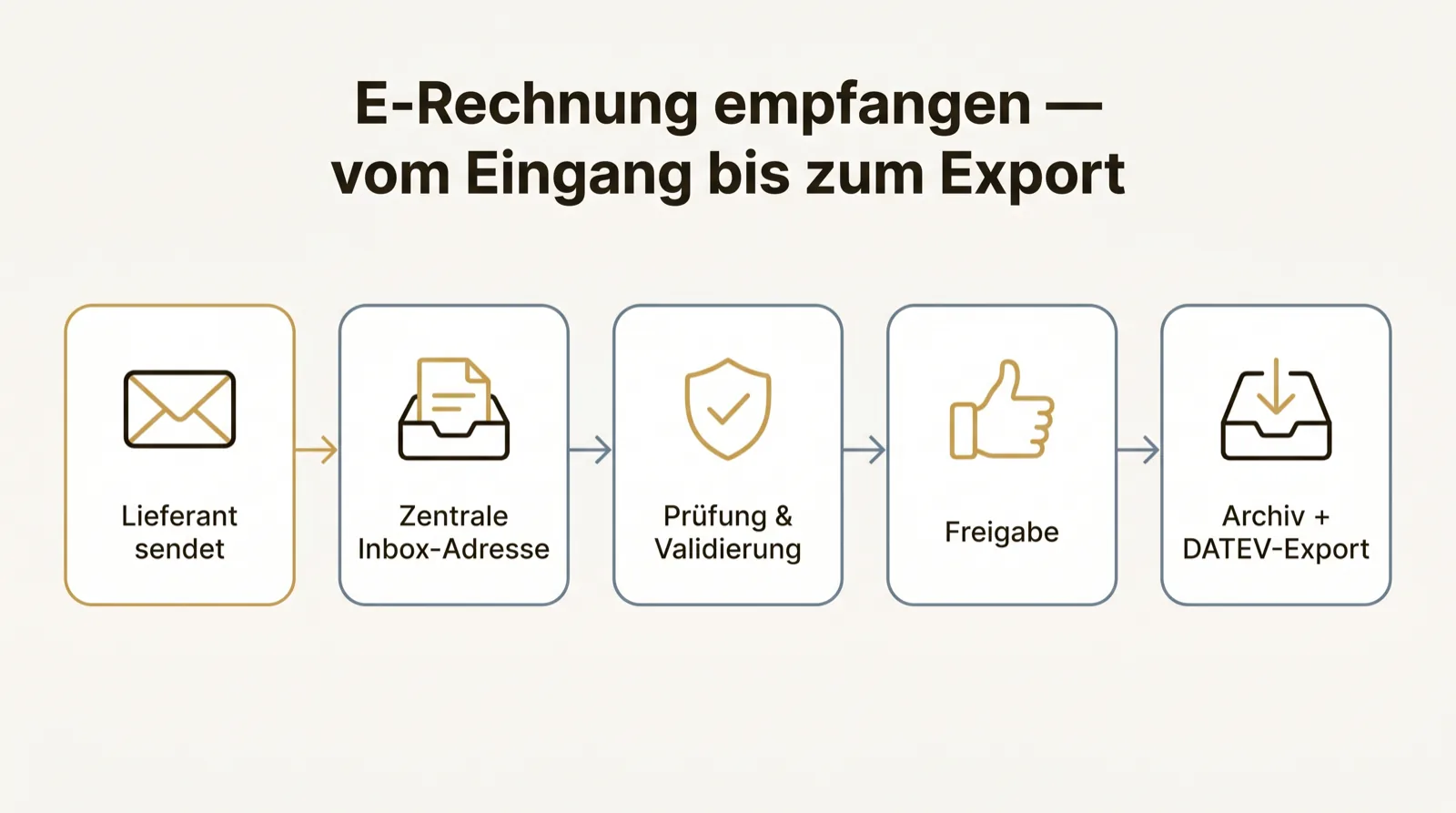
A resilient invoice intake is not “open mail, look at attachment”. It has five clearly separated stations. First acceptance via a fixed address. Then validation against the norm. Then making it visible so a human can read and check the invoice. Then approval by the responsible person. And finally audit-proof archiving plus hand-over to accounting.
Each station has a different purpose — and each is individually verifiable. That is what turns an inbox into a process that survives an audit.
Validation: how real checking is recognizable
“Received” does not mean “filed in a folder”. An e-invoice can be formally broken even though it looks like an invoice.
A serious check looks at more than the appearance: does the file match the EN 16931 schema? Are the mandatory details under § 14 UStG present — complete address, tax number or VAT ID, service date? Does the totals logic add up, do net, tax and gross together equal the stated amount? Does the tax rate match the service?
If one of these points fails, the invoice should not enter the approval run at all. A faulty invoice that gets posted anyway costs far more time later than one rejected cleanly at intake.
Think about archiving from second one
The mistake almost everyone makes: they deal with archiving once the year is over. Too late.
The GoBD require you to keep the received original unchanged — and the original of an XRechnung is the XML, not the pretty printout. Whoever saves only a PDF has lost the machine-readable document. The retention period for invoices as accounting vouchers is generally eight years; for certain records it stays ten.
That is why audit-proof storage belongs at the start of the process, not the end. Every invoice is secured at the moment of intake in its original format — timestamped and unalterable.
What to do before the next month-end close
You do not need an ERP to receive cleanly. You need a clear, always-identical path. The following points can be done in half a day and take most of the pressure off:
- Set up a fixed inbound address used only for invoices — not the general info@ mailbox.
- Communicate this address actively to your suppliers, in writing, with a cut-off date.
- Define who checks and approves invoices — one person, one deputy.
- Make sure the XML original is archived, not just a PDF view.
- Define the hand-over path to accounting or the tax advisor once, cleanly (DATEV export, posting batch, voucher link).