The mix-up that catches almost everyone
For years the rule was: invoice by post is analog, invoice by mail is digital. That simple split has not worked since 2025.
The legislator now distinguishes not by the transmission route but by the format. An invoice mailed as a PDF is, in the sense of § 14 UStG, an “other invoice” — legally closer to paper than to the e-invoice. That surprises many but is the core of the whole reform.
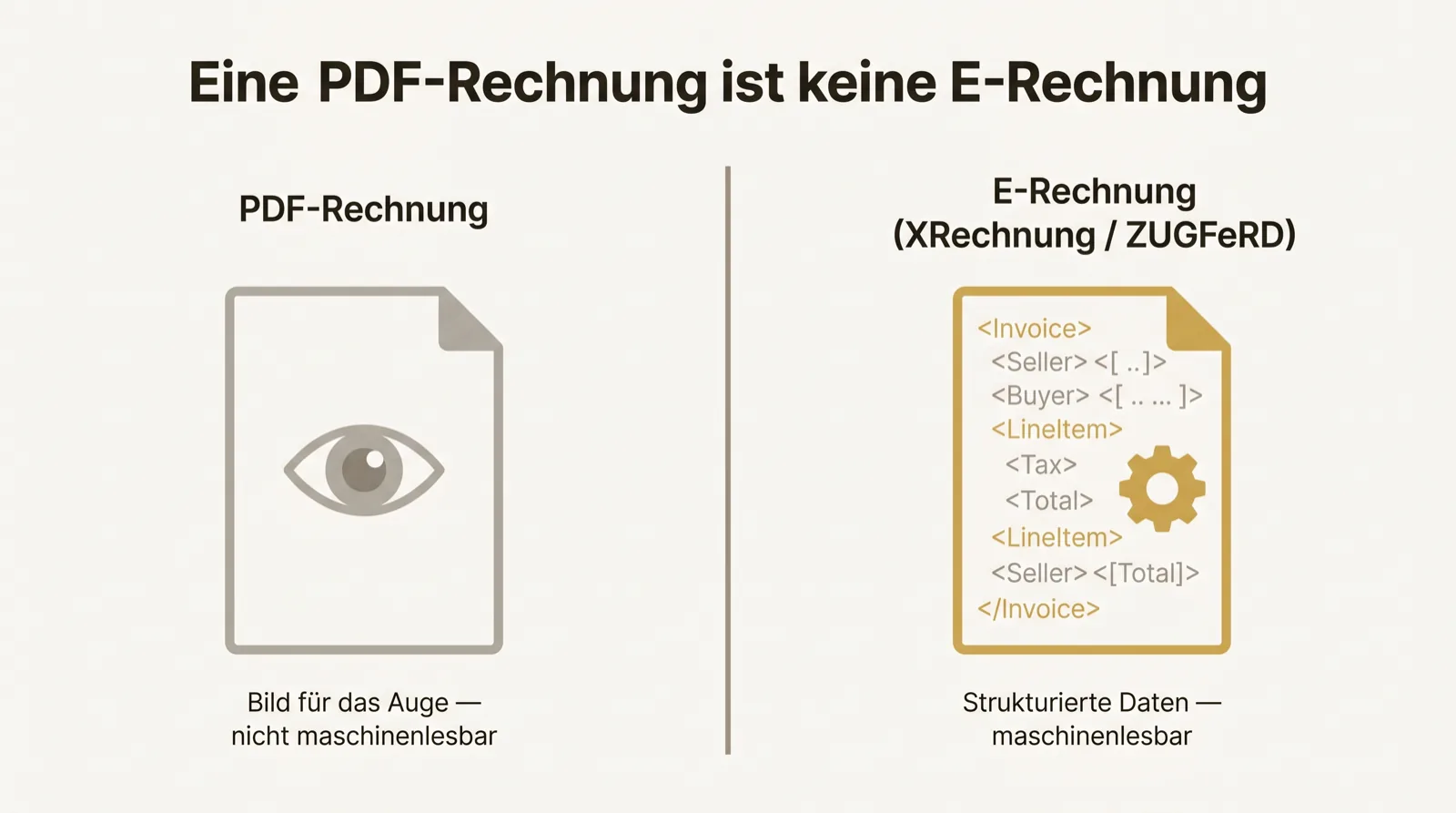
What a PDF really is: a picture for humans
Open a PDF invoice and you see a clean document: logo, table, total. For you as a human, perfectly readable.
For a machine it is not. The program sees a surface of pixels and text fragments without reliable meaning. Where is the net amount? Which number is the invoice number, which the date? The PDF does not “know”. Software has to guess — via text recognition, error-prone. It was exactly this guessing the legislator wanted to abolish.
What an e-invoice is: data for machines
An e-invoice contains the same information — but unambiguously labelled. Every field is clearly named: this is the invoice number. This is the net amount. This is the 19 percent tax rate on this line.
The software no longer has to guess. It reads the values directly, checks them against the norm and takes them into accounting. Fewer typos, fewer queries, less rework. That is the actual point of the whole thing — not bureaucracy, but less manual retyping.
XRechnung and ZUGFeRD — two ways, one norm
Two formats meet you in Germany. The XRechnung is a pure XML file: only data, no appearance. ZUGFeRD is a hybrid — an ordinary PDF with an additionally embedded XML file.
The trick with ZUGFeRD: you see a familiar PDF and can read it as always. The machine reads the hidden XML in parallel. Both formats meet EN 16931 and count as a real e-invoice — provided the ZUGFeRD profile at least matches the norm (from profile EN 16931, formerly called “Comfort”).
Why the legislator is sorting out the plain PDF
The reform has a concrete goal: curb VAT fraud and automate processes. Structured data can be reconciled by machine, a PDF cannot reliably.
Hence the staged plan for sending: since 2025 paper and PDF may only be sent with the recipient's consent. This tolerance runs out in 2026, a year longer for smaller companies up to EUR 800,000 prior-year turnover. From 2028 the e-invoice in B2B is effectively without alternative. Receiving, by contrast — this is often confused — must already work today.
Do I still get PDFs? Yes — and that's fine for now
No one forbids you from continuing to receive PDFs. Many small suppliers will still send classic invoices during the transition anyway. You do not have to reject them.
What matters is the mental separation: a PDF you continue to treat as before. An incoming XRechnung or ZUGFeRD invoice needs the structured path — validation, readable view, archiving of the original. Whoever keeps the two worlds cleanly apart has the transition under control.
How to tell in seconds what you received
You do not have to become a format expert. A short checklist is enough for everyday use:
- File extension .xml in the attachment → an XRechnung. That is a real e-invoice.
- A PDF that opens but also shows an embedded file → probably ZUGFeRD. Real e-invoice.
- Plain PDF without embedded data → “other invoice”, not an e-invoice in the legal sense.
- Photo or scan of a paper invoice → also not an e-invoice.
- In doubt: software that detects the format automatically takes this distinction off your hands entirely.