The ERP reflex and why it misleads
E-invoicing sounds like a big IT project, so people think of an ERP. But the obligation that is acute now is receiving — and receiving is a delimited task, not a company operating system.
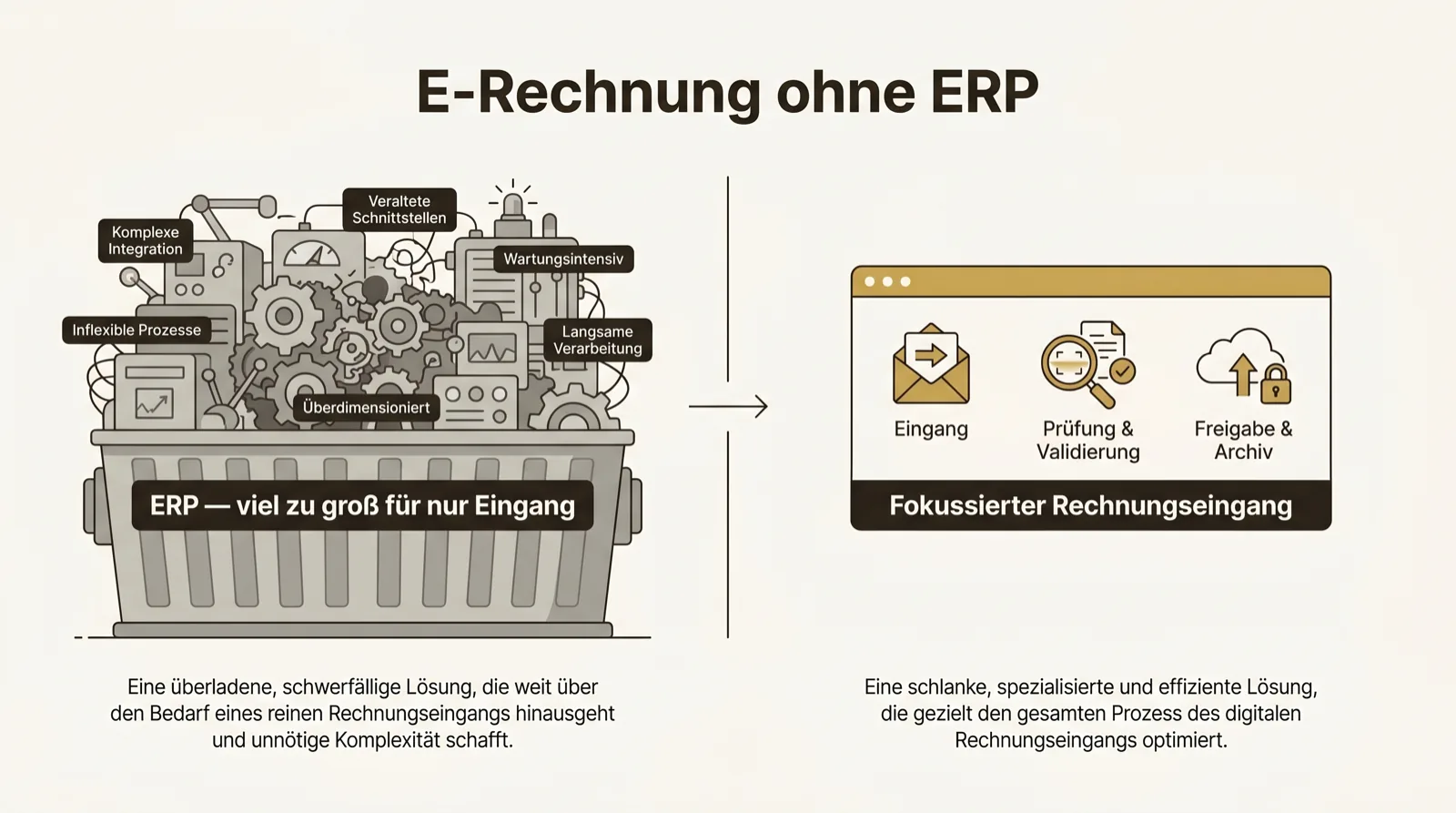
An ERP manages goods, production, HR, finance. Of that you need almost nothing for “accept an XRechnung and keep it correctly”.
Receive e-invoices · Check an e-invoice for free
What receiving really needs
The task is clearly delimited: accept, detect format, validate, approve, archive the original audit-proof, hand cleanly to accounting or the firm. That is a lot but it is narrowly defined.
Exactly this chain is covered by a specialized inbox solution — without the complexity, the introduction time and the cost of an ERP.
When an ERP does make sense
Honest: there are cases where an ERP fits — complex goods management, order reference, production control, many integrated processes. If you run that anyway, the e-invoice slots in there.
The point is not “ERP is bad”. The point is: introducing an ERP just because of the e-invoicing obligation is the most expensive answer to a comparatively small question.
The cost side no one likes to mention
An ERP project costs not just a licence. It costs introduction, training, customization, maintenance — and months in which the actual obligation (receiving) is still unsolved.
A focused solution is productive in days instead of months. Especially for small and medium businesses this time-to-compliance is the decisive factor, not the feature list.
How to tell that “without an ERP” is enough
An honest self-assessment:
- You mainly want to receive and keep supplier invoices cleanly.
- You have a tax advisor or existing accounting.
- You do not need integrated goods management for this task.
- You want to be compliant in days, not in quarters.
- Then a focused invoice intake is the fitting, not the smaller, solution.