Audit-proof means: provably unchanged
At its core audit-proof means just one thing: you can prove a document has not been changed since intake — and that nothing is missing. Not “we saved it” but “we can prove it”.
Exactly this proof is what separates an archive from a folder.
Receive e-invoices · DATEV handover
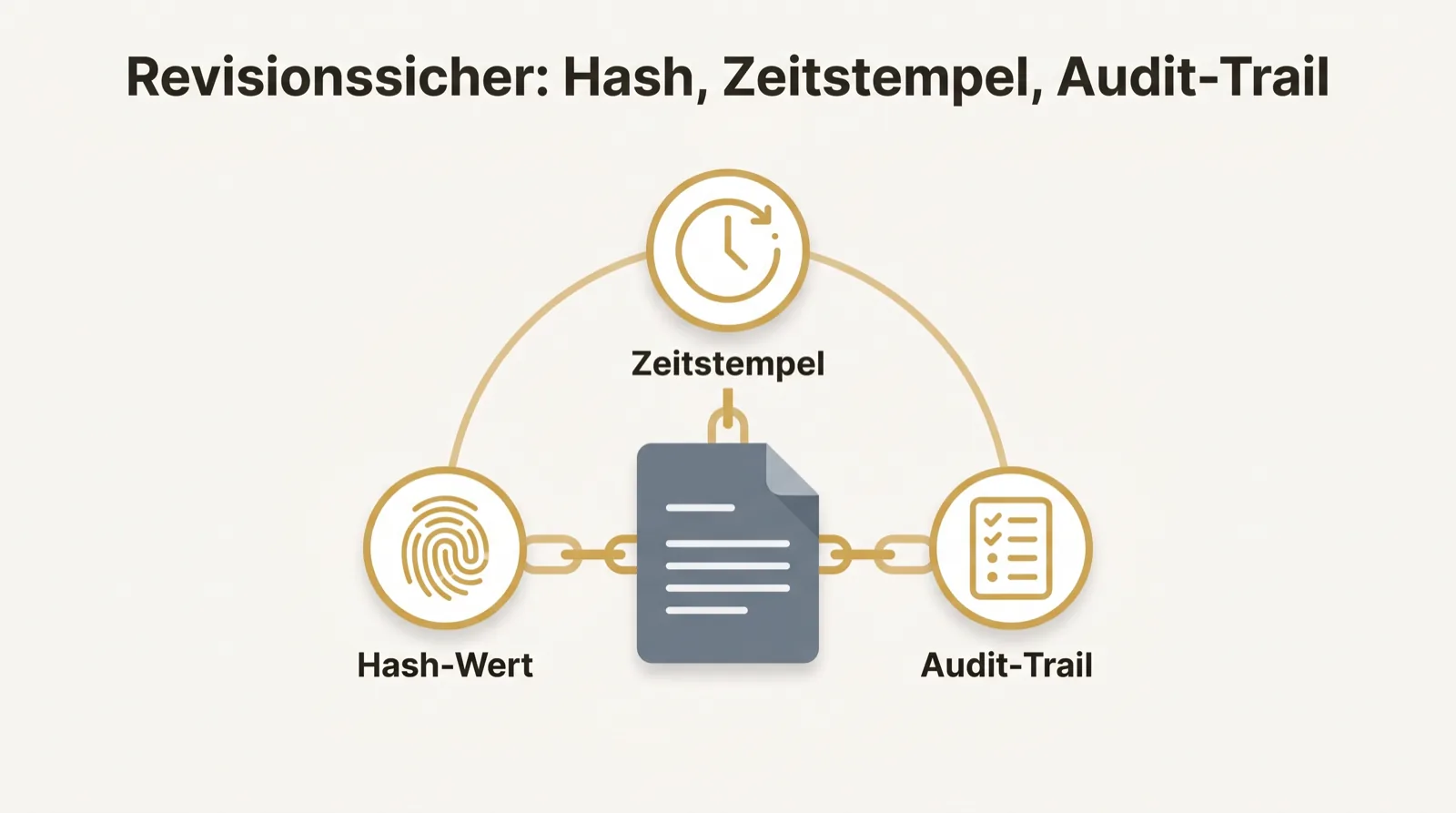
The hash: the digital fingerprint
A hash is a short checksum computed from the file's content. If even one character changes, the hash changes completely. Keep the hash from the intake moment and you can later show at any time: identical file or not.
You do not have to understand the math behind it. The comparison “hash then = hash now” is the whole trick — and a very strong one.
The timestamp: when it was so
A hash says something is unchanged. The timestamp says since when. Only both together yield a robust proof: this file was in this state at this point in time.
Especially with long retention periods the “since when” is decisive — years later nobody remembers, but the timestamp does.
The audit trail: who did what
The audit trail is the seamless log: arrived, checked, approved, exported — with timestamps. Not the document itself, but its history.
In an audit exactly this history is asked for. “Who approved this?” is answered by no PDF, but by an audit trail.
Why this matters especially with e-invoices
A paper invoice in the file folder carries its unalteredness visibly. An XML file does not — it can be changed silently. That is exactly why the structured original needs the technical proof it does not bring on its own.
Hash, timestamp and audit trail are not a gimmick. They are what the GoBD practically mean with electronic documents — the substitute for “you can see it on the paper”.