The auditor asks for the original, not the printout
With paper the folder was enough. With e-invoices the audit asks specifically: show me the structured original for this posting. A pretty printout is then the wrong answer.
Whoever cannot present the XML weakens the orderliness — even if the figures are right. The form is here part of the content.
Receive e-invoices · DATEV handover
Data access: Z1, Z2, Z3
The tax authority can access in different ways: directly in the system, indirectly via evaluations or by handing over a data carrier. Behind the abbreviations stands a simple expectation: the tax-relevant data must be available machine-evaluable.
That is why the discarded XML is so dangerous. A picture cannot be evaluated by machine — the basis for this access is then missing.
Which evidence counts
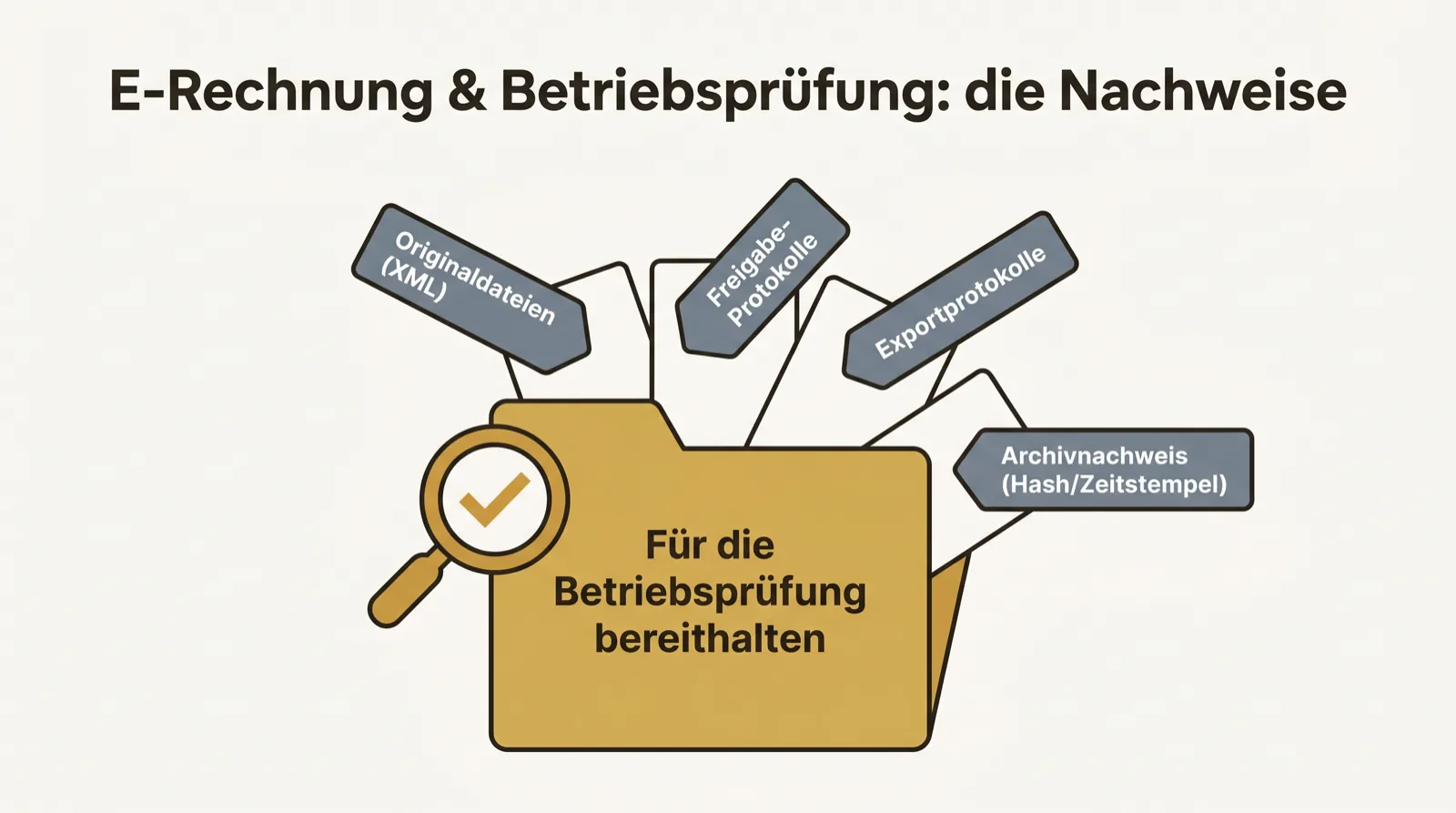
Beyond the invoice the audit wants to see the history: when did it arrive? Who checked and approved it? When and how was it exported? Is the original unchanged?
These are not harassment questions. They are exactly the points that prove completeness, traceability and unalterability — the core requirements of the GoBD.
The procedural documentation as a door opener
A current procedural documentation matching the lived practice changes the tone of an audit. It shows: nothing was improvised here, there is a process.
If it is missing or describes something other than reality, the opposite impression arises — and auditors then look more closely.
What you should keep ready
So the audit runs calmly:
- The structured original files, unchanged and findable.
- Approval and check logs per document.
- Export logs toward accounting/DATEV.
- Archive proofs: hash, timestamp, unalterability.
- A current procedural documentation matching practice.