Brief recap: what already applies
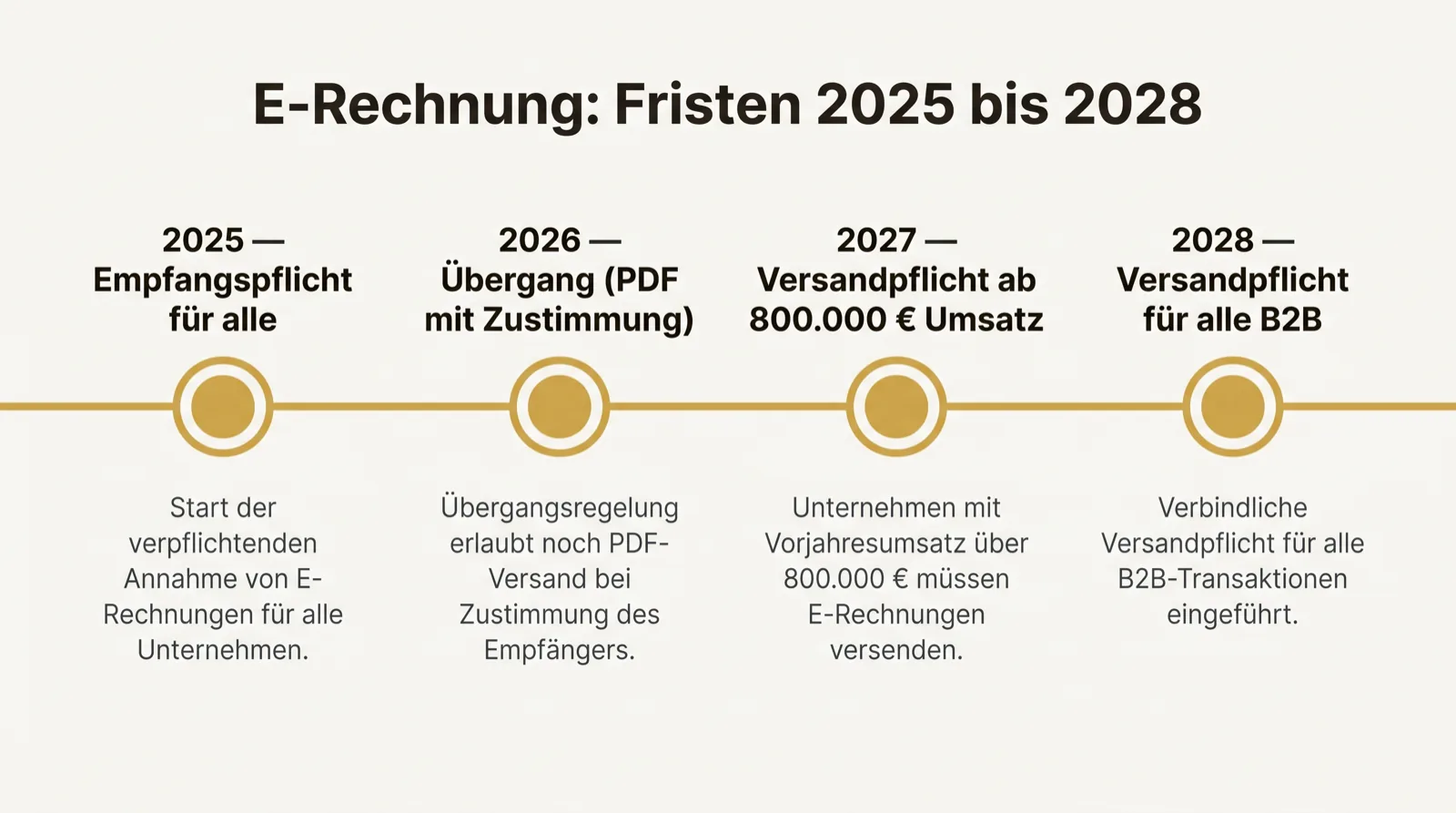
Since 1 January 2025 every company in domestic B2B must be able to receive e-invoices. That is not the future, that is the present. For sending a staged transition applies.
It is precisely this staging that causes confusion. Many hear “2027” or “2028” and conclude they still have time. For receiving that is wrong — it has long been mandatory.
Receive e-invoices · Check an e-invoice for free
The EUR 800,000 threshold
Until the end of 2026 in principle everyone may still send paper or PDF, provided the recipient consents. From 2027 this possibility falls away for companies with more than EUR 800,000 total turnover in the prior year. They must then issue structured e-invoices.
Smaller companies below the threshold get another year of tolerance. Decisive is the prior-year turnover — so whoever breaks the threshold in 2026 is up in 2027.
What “sending obligation” means in practice
It means more than “rename PDF to XML”. Your outgoing invoices must have a norm-compliant format under EN 16931 — XRechnung or ZUGFeRD in the right profile — with all mandatory fields, correct tax logic and a machine-readable structure.
This concerns your invoicing or ERP system, your master data, possibly your number ranges. Such conversions need lead time. 2027 is closer than it sounds in 2025.
Why receiving is the more urgent task
Here is the honest prioritization: sending has a deadline with lead time. Receiving has none — it applies now.
A supplier already sending XRechnung does not wait for 2027. If your intake does not work today, you have a problem today, not in two years. Sensible order: first set receiving up cleanly, then prepare sending at leisure.
A sensible order through 2027
Whoever proceeds in a structured way avoids the rush:
- Now: ensure receiving — fixed address, validation, original archive.
- 2026: check the invoicing/ERP system for norm-compliant e-invoice sending.
- 2026: tidy up master data and account assignment, generate test invoices.
- Before 2027: pilot the sending process, inform suppliers and customers.
- Ongoing: keep an eye on prior-year turnover — it decides your start year.