Four tools, four purposes
The fallacy is to see the four as alternatives for the same task. They are not. An ERP steers the whole company. A DMS manages documents. DATEV is the bookkeeping and firm backbone. A specialized inbox takes care of exactly the invoice intake.
The right question is not “which is better” but “which problem am I solving right now”.
Receive e-invoices · Check an e-invoice for free
| Tool | Core job | Role in invoice intake |
|---|---|---|
| ERP | Run the whole company | E-invoicing as part of a large system |
| DMS | Manage and archive documents | Strong storage; intake validation is often not its core |
| DATEV | Bookkeeping and tax-firm work | Destination for clean posting data and documents |
| Specialized inbox | Validate and hand off invoice intake | Upstream layer for receipt, approval, archive, and export |
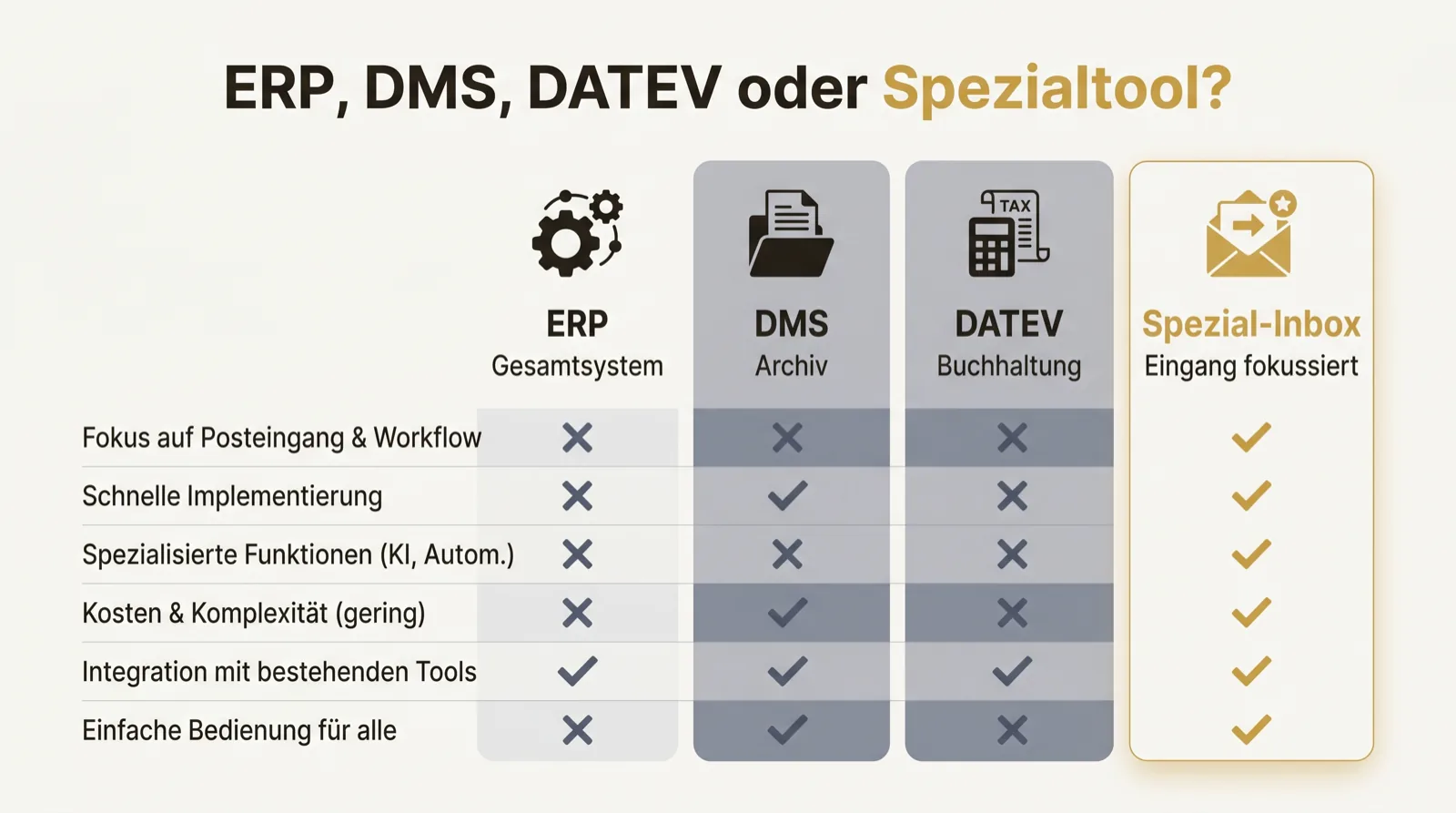
ERP: strong but heavy
An ERP can do almost everything, including e-invoicing — as part of a big whole. The price is complexity, introduction time and a feature scope of which you need only a fraction for the intake.
If you run an ERP anyway, use it. Introducing it just because of the e-invoicing obligation is the most expensive conceivable answer.
DMS and DATEV: important but not the intake
A DMS archives excellently but rarely validates e-invoices out of the box. DATEV is made for bookkeeping and firm work, not as an upstream checking intake.
Both are indispensable at their core — but neither covers the chain intake–validation–approval–original-archive–export fully on its own.
Specialized tool: exactly this gap
A specialized inbox is tailored to exactly the gap ERP, DMS and DATEV leave open: the checked, archived, cleanly handed-over invoice intake. It does not replace the others — it feeds them.
Decision guide
Honestly asked:
- Do I need a whole system for the company? → ERP (if present anyway).
- Do I mainly need document storage? → DMS, but intake check missing.
- Do I need bookkeeping/firm? → DATEV, but check upstream.
- Do I need exactly the checked invoice intake? → specialized inbox.
- Mostly it is not either-or but inbox before DATEV/DMS.