What Peppol even is
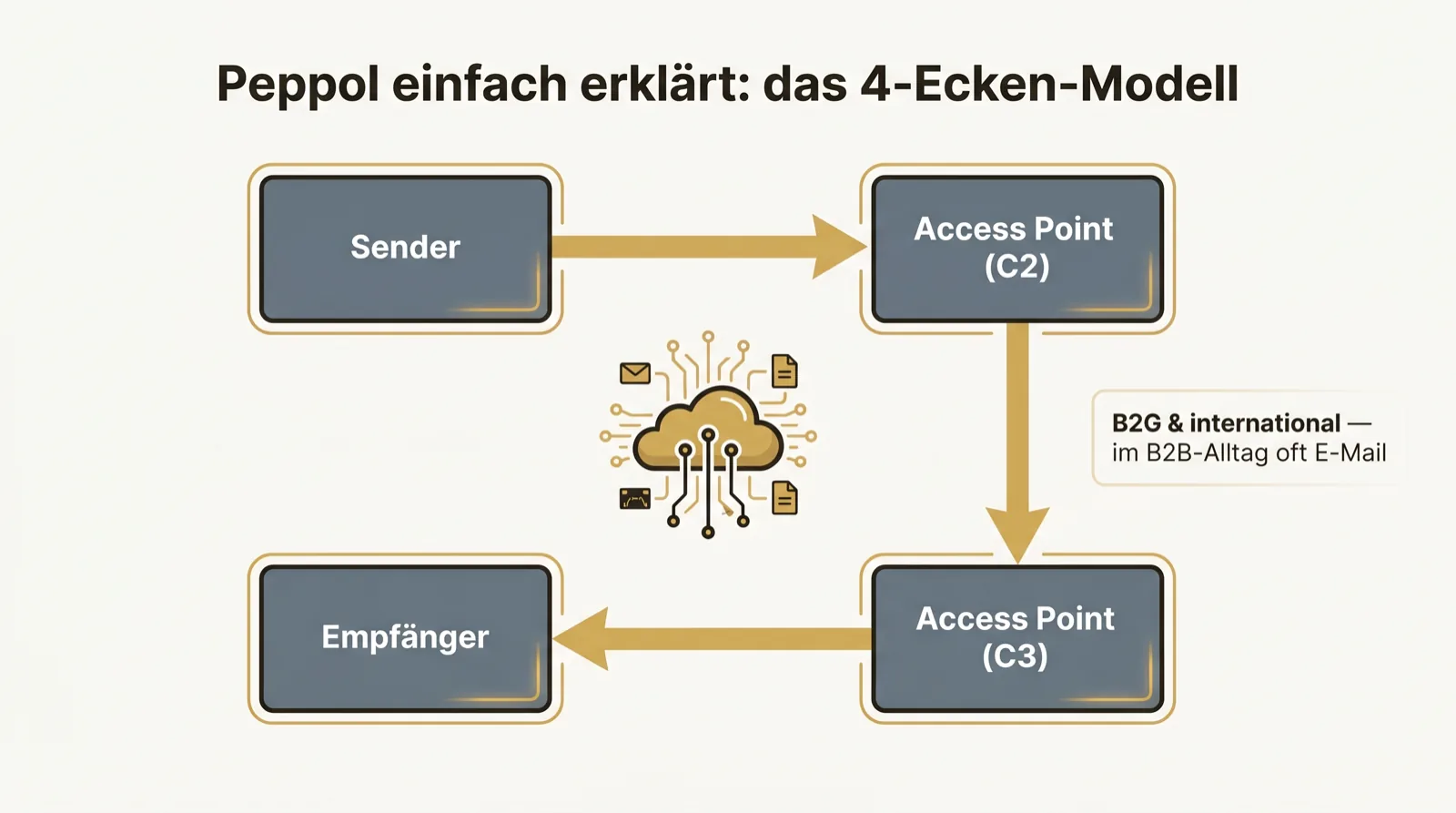
Peppol is an international network for the standardized exchange of electronic business documents. Instead of mailing invoices, sender and recipient hand them over via certified access points — the so-called four-corner model.
Think of it as a postal network for structured documents: two participants, two access points in between, one uniform standard.
Receive e-invoices · Check an e-invoice for free
Where Peppol is really relevant today
In public procurement (B2G) and in international business Peppol is established and partly expected. Whoever regularly invoices authorities in several countries comes into contact with it.
In the typical domestic B2B everyday of an SME it is often not. The law prescribes no Peppol connection for receiving — an e-mail access is enough.
The common fallacy
Many equate the e-invoicing obligation with a Peppol obligation. That is wrong. The obligation concerns the format (EN 16931) and the receiving capability, not the transmission route.
You must be able to receive XRechnung and ZUGFeRD — over which channel is largely up to you. Peppol is an option, not a compulsion.
A look ahead: ViDA
At EU level, with the “VAT in the Digital Age” initiative, stronger standardization and reporting obligations are emerging. That can medium-term raise the importance of network-based transmission.
The honest classification: watch it, yes. Fall into actionism, no. Whoever sets receiving up cleanly today has built the best basis for such developments — regardless of the channel.
Rule of thumb for SMEs
In short:
- Pure domestic B2B receiving → e-mail/inbox is enough, Peppol no must.
- Regular B2G or international invoices → Peppol becomes relevant.
- E-invoicing obligation ≠ Peppol obligation — format and receiving count.
- Keep an eye on ViDA, but set receiving up cleanly now.
- A connection can be added later if a concrete need arises.